





From the Feed
Short Reflections
Ideas first shared on Instagram & LinkedIn, gathered here to read in full.

Before the Dose, Meet Your Protectors
Before the dose, meet your protectors.
One of the most important questions in psychedelic preparation is not only: “What is your intention?”
But: “Which parts of you are already preparing for this experience?”
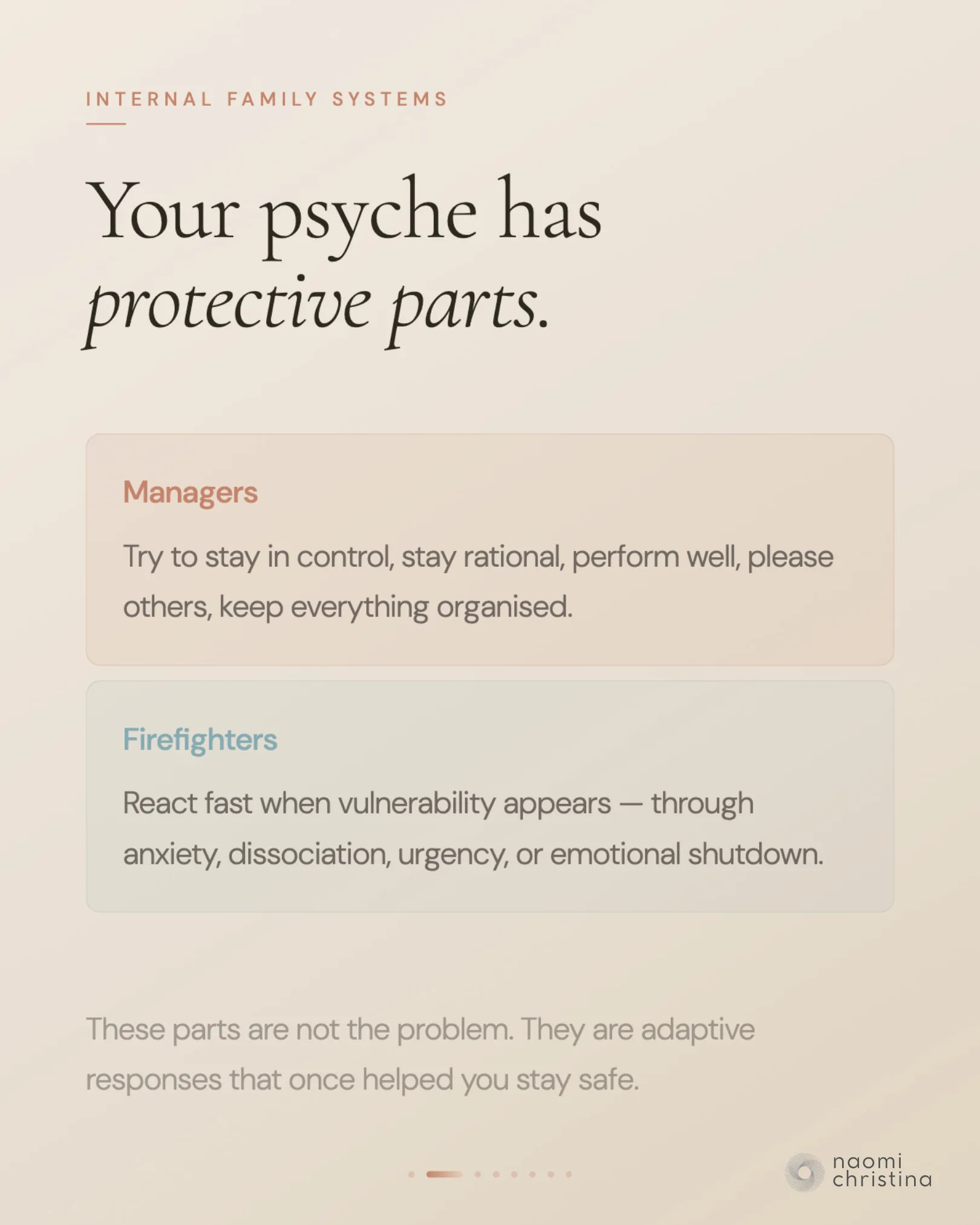
In Internal Family Systems (IFS), we work with protective parts of the psyche. Some try to stay in control, stay rational, perform well, please others, or keep everything organised. Others react quickly when vulnerability appears through anxiety, dissociation, urgency, distraction, or emotional shutdown.
These parts are not the problem.
They are adaptive responses that once helped us stay safe. But psychedelics tend to amplify the existing dynamics of the inner system.
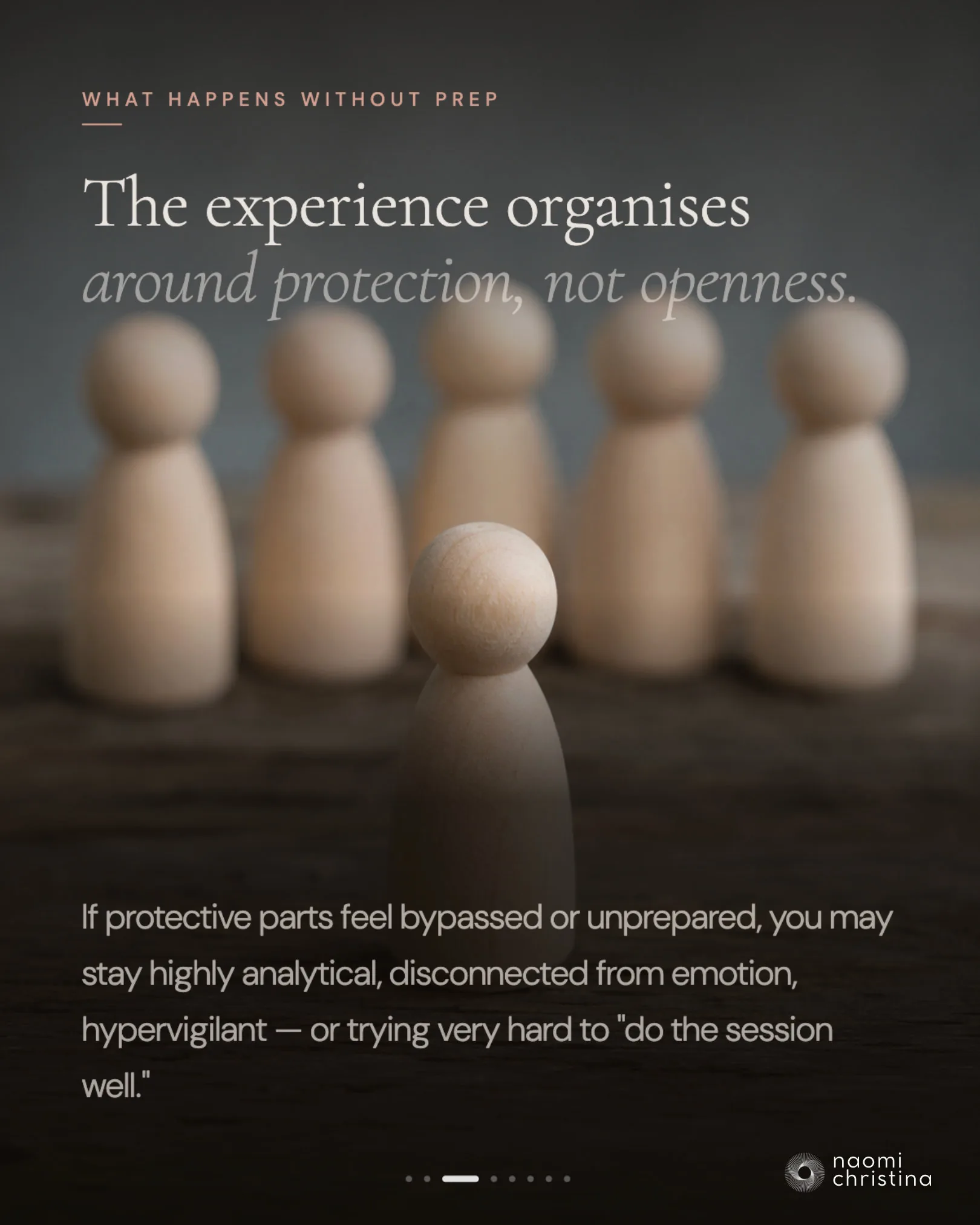
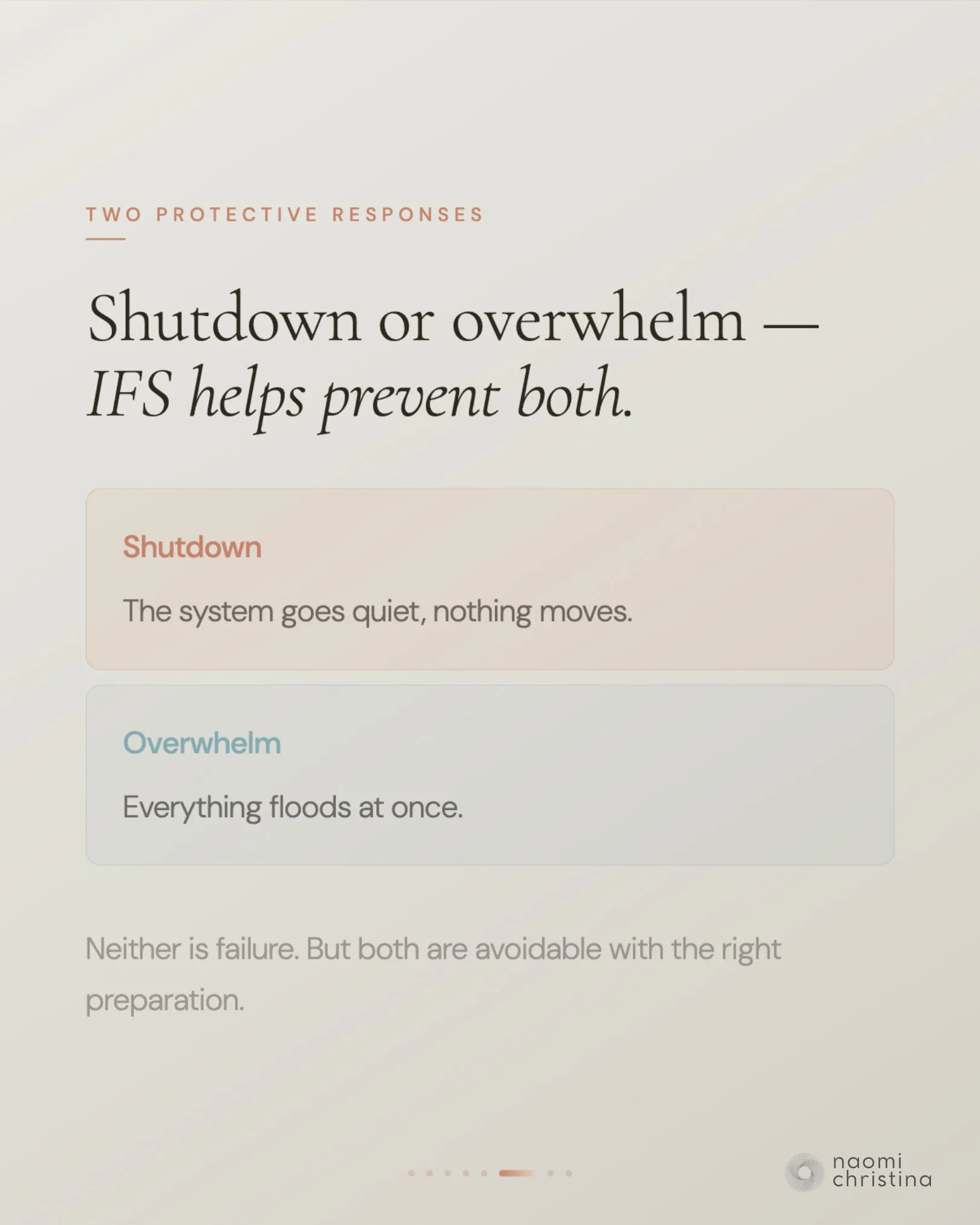
If protective parts feel frightened, bypassed, or unprepared, the experience itself can become organised around protection rather than openness. Someone may stay highly analytical, disconnected from emotion, hypervigilant, overwhelmed, or trying very hard to “do the session well.”
This is why preparation matters psychologically, not only practically.
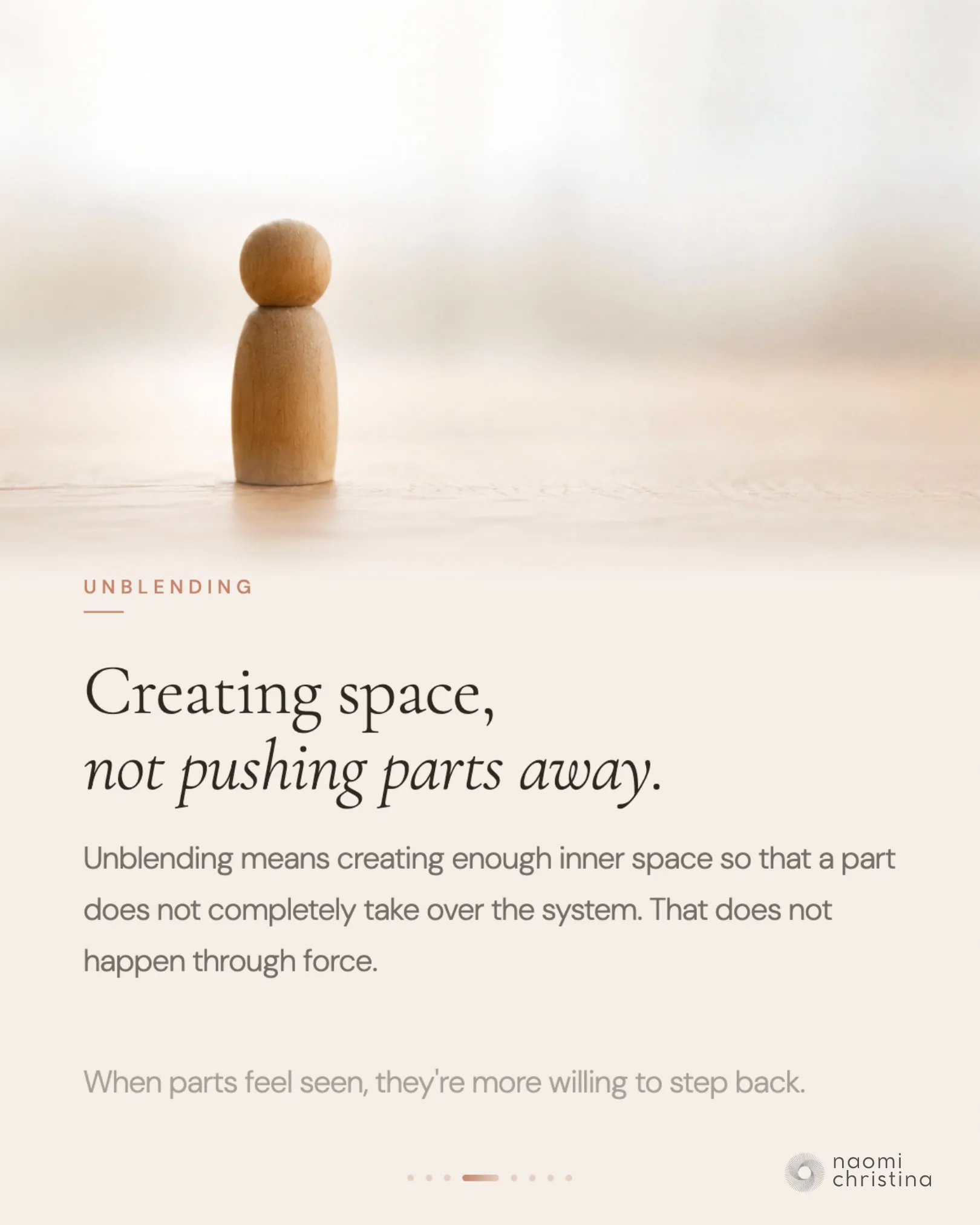
In IFS, we speak about unblending: creating enough inner space so that a part does not completely take over the system.
That does not happen through force.
Protectors do not soften because they are pushed aside. They soften when they feel listened to, respected, and included in the process.
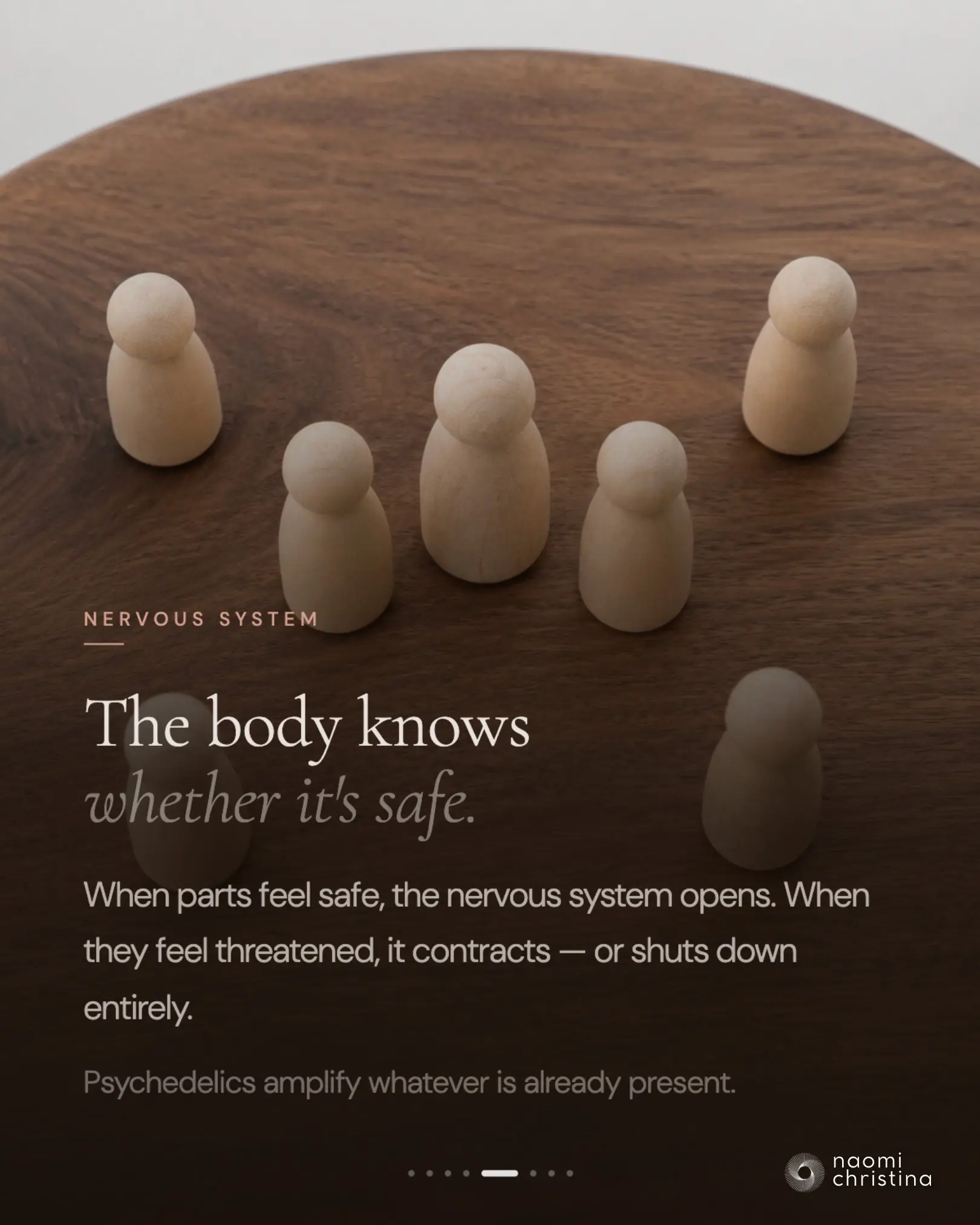
The nervous system responds to this distinction.
When protective parts experience enough safety and trust, the system becomes more able to open. When they fear overwhelm, exposure, or loss of control, the system contracts or shuts down.
Psychedelics do not bypass the nervous system. They amplify what is already there.
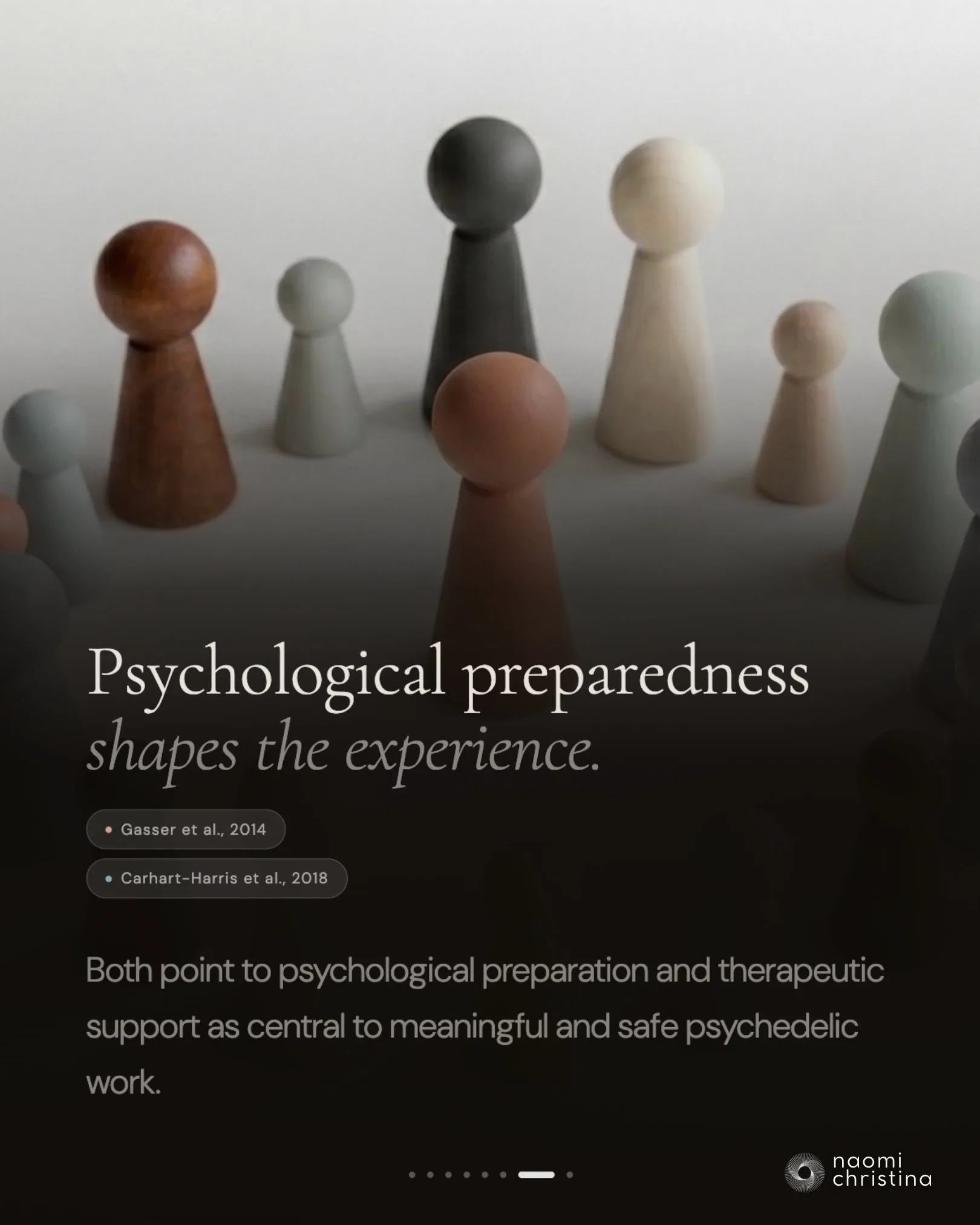
Research by Gasser et al. and Carhart-Harris et al. consistently points to psychological preparation and therapeutic support as central to meaningful and safe psychedelic work.
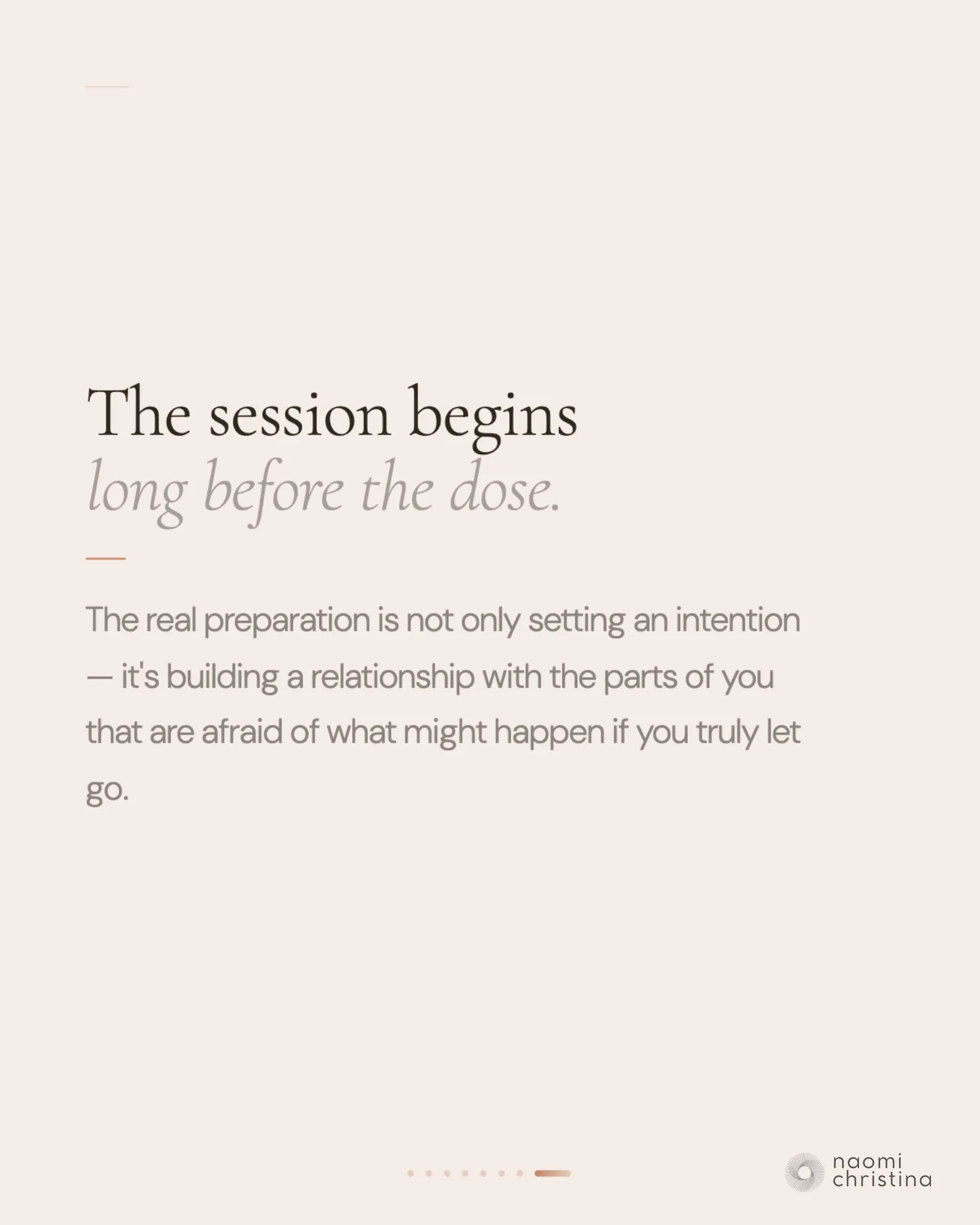
The session begins long before the dose.
Often, the real preparation is not only setting an intention but building a relationship with the parts of you that are afraid of what might happen if you truly let go.
- Gasser, P., Holstein, D., Michel, Y., Doblin, R., Yazar-Klosinski, B., Passie, T., & Brenneisen, R. (2014). Safety and efficacy of lysergic acid diethylamide-assisted psychotherapy for anxiety associated with life-threatening diseases. Journal of Nervous and Mental Disease, 202(7), 513–520.
- Carhart-Harris, R. L., Bolstridge, M., Day, C. M. J., Rucker, J., Watts, R., et al. (2018). Psilocybin with psychological support for treatment-resistant depression: six-month follow-up. Psychopharmacology, 235(2), 399–408.

How Does It Feel When the Self Is Leading?
How does it feel when the Self is leading?
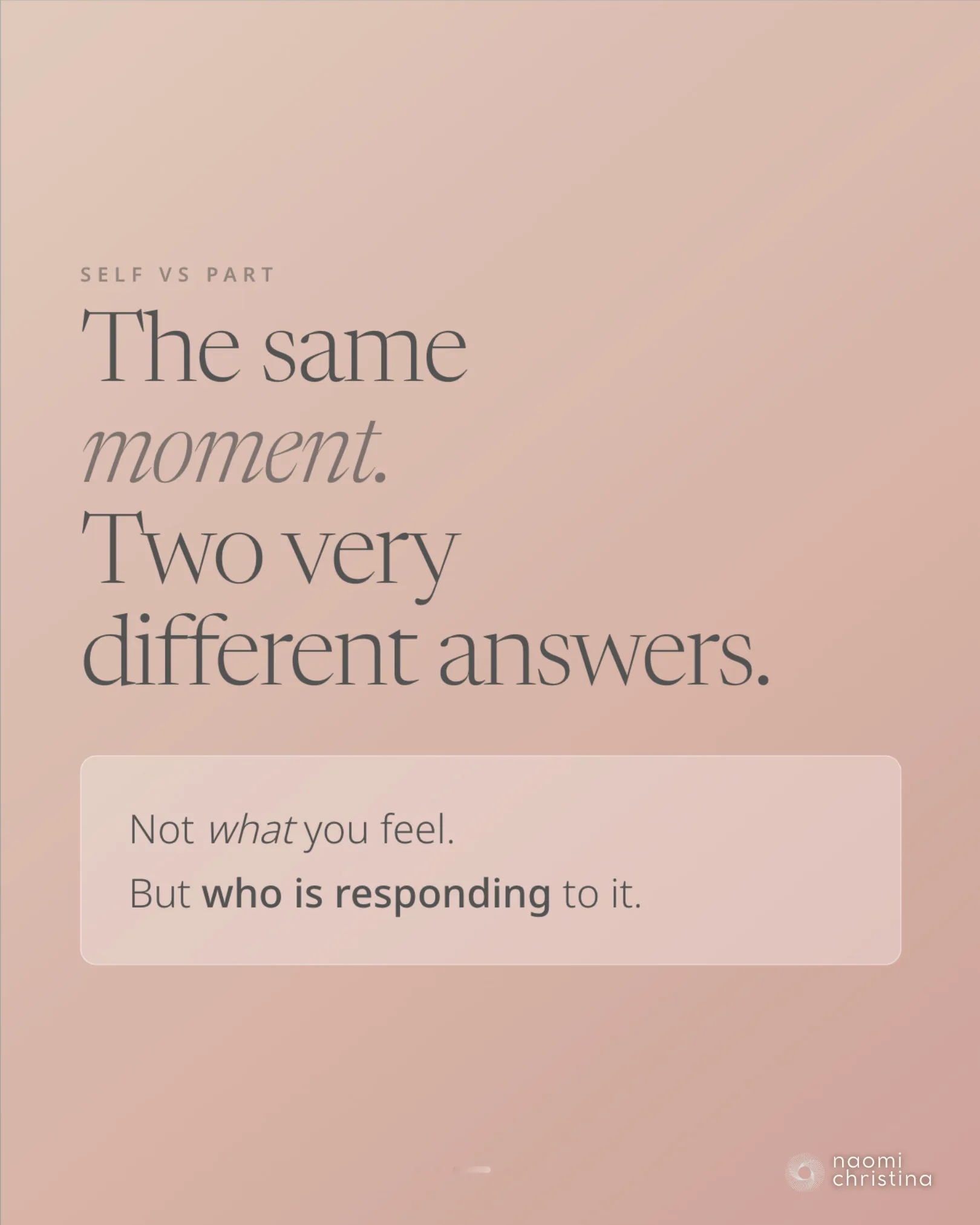
Following our IFS series, this post explores what it actually feels like when Self is present — and how it differs from moments when one of our parts has taken over.
If you're new to Internal Family Systems (IFS), a little context may help. IFS suggests that we all have different parts within us. Parts are not a sign that something is wrong. They are aspects of our personality that developed over time to help us navigate life.
You may recognize an inner critic that tells you you're not good enough. A worrier that constantly thinks about what could go wrong. A pleaser that wants everyone to be happy. Or an achiever that keeps pushing you to do more.
In my experience, everyone has parts like these.
And when one of them takes over, it can feel as though it becomes the whole of who we are.
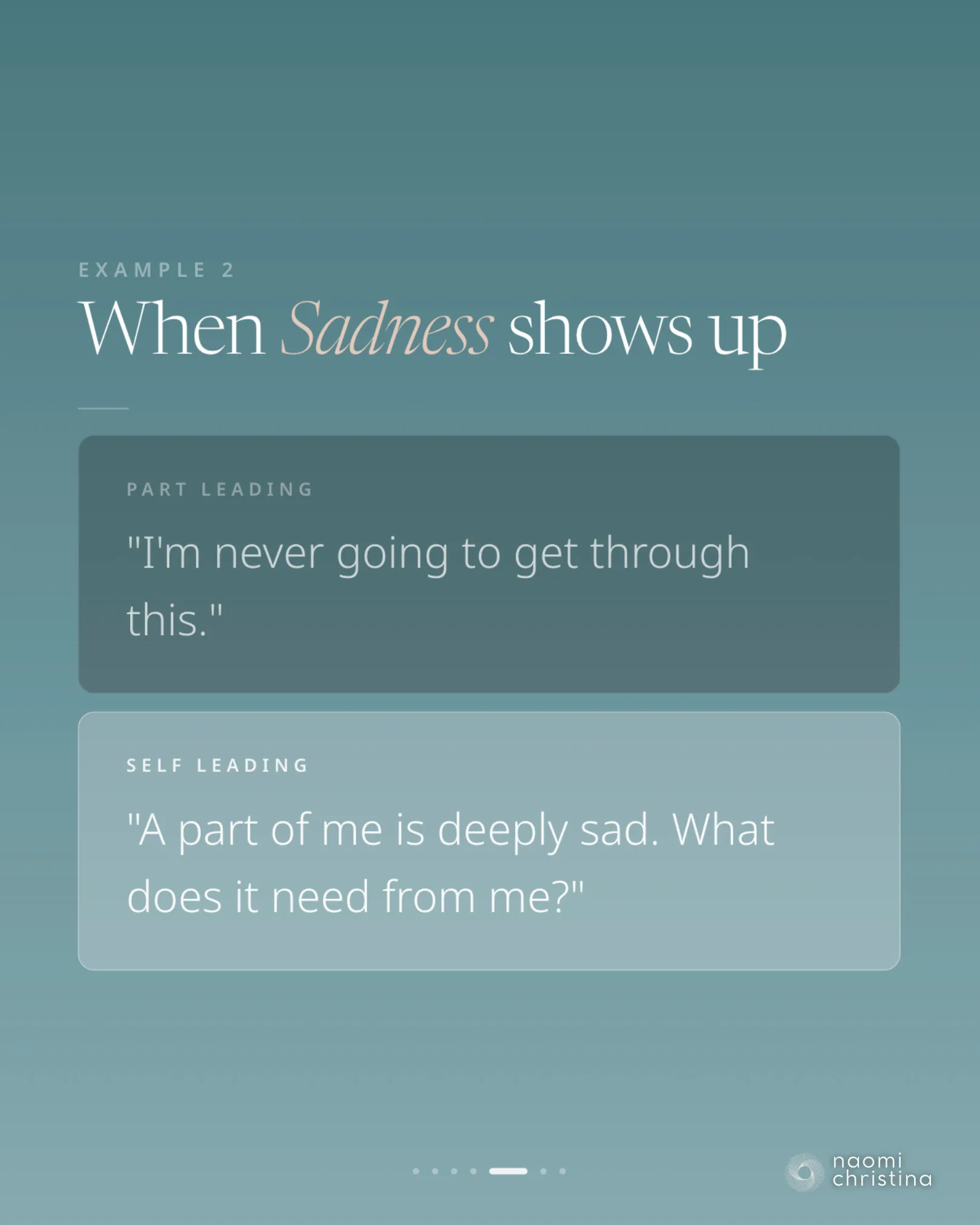
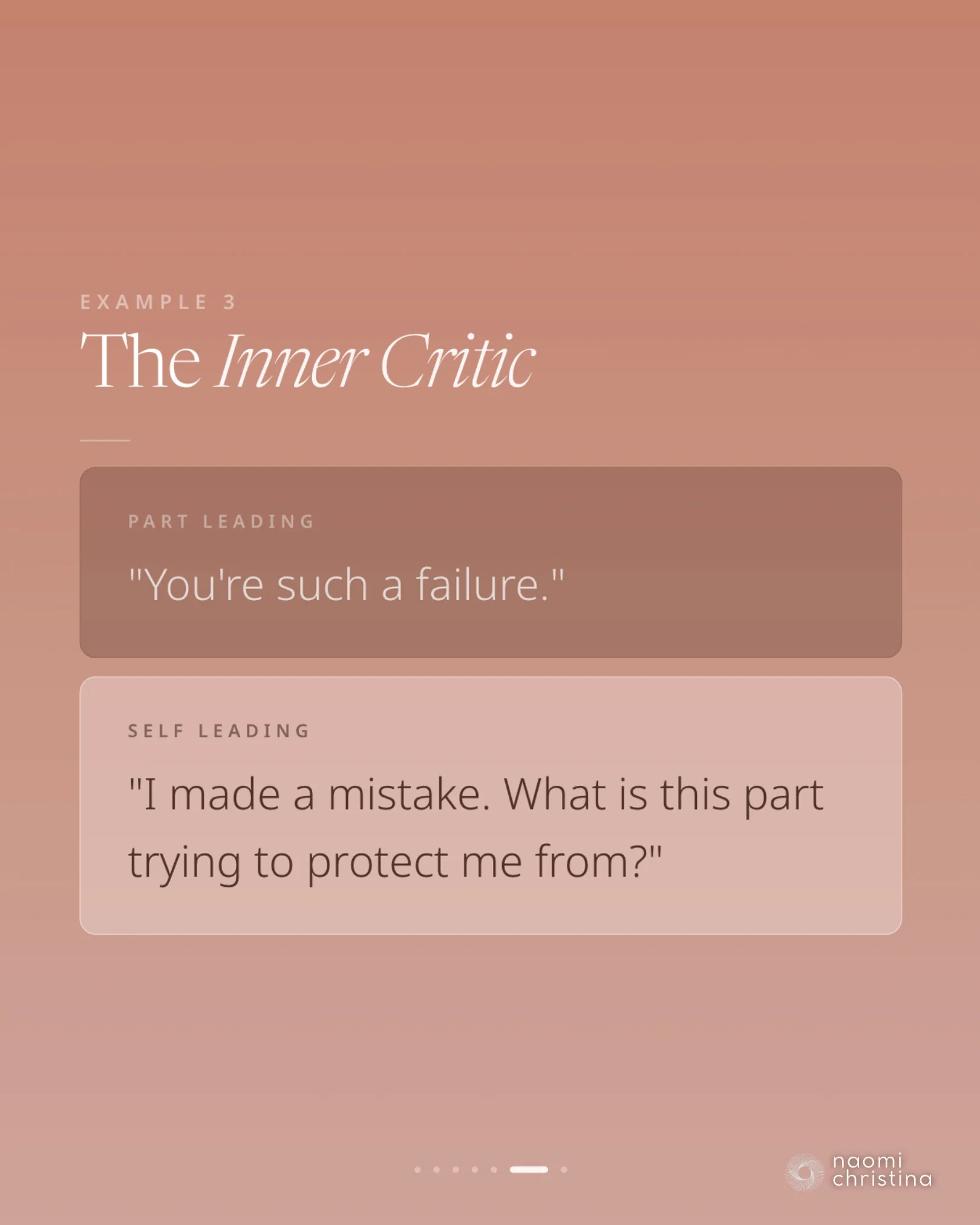
The inner critic says: "You should have done better." And suddenly we believe it.
The worrier says: "What if everything goes wrong?" And suddenly that feels true as well.
But according to IFS, there is something deeper than our parts.
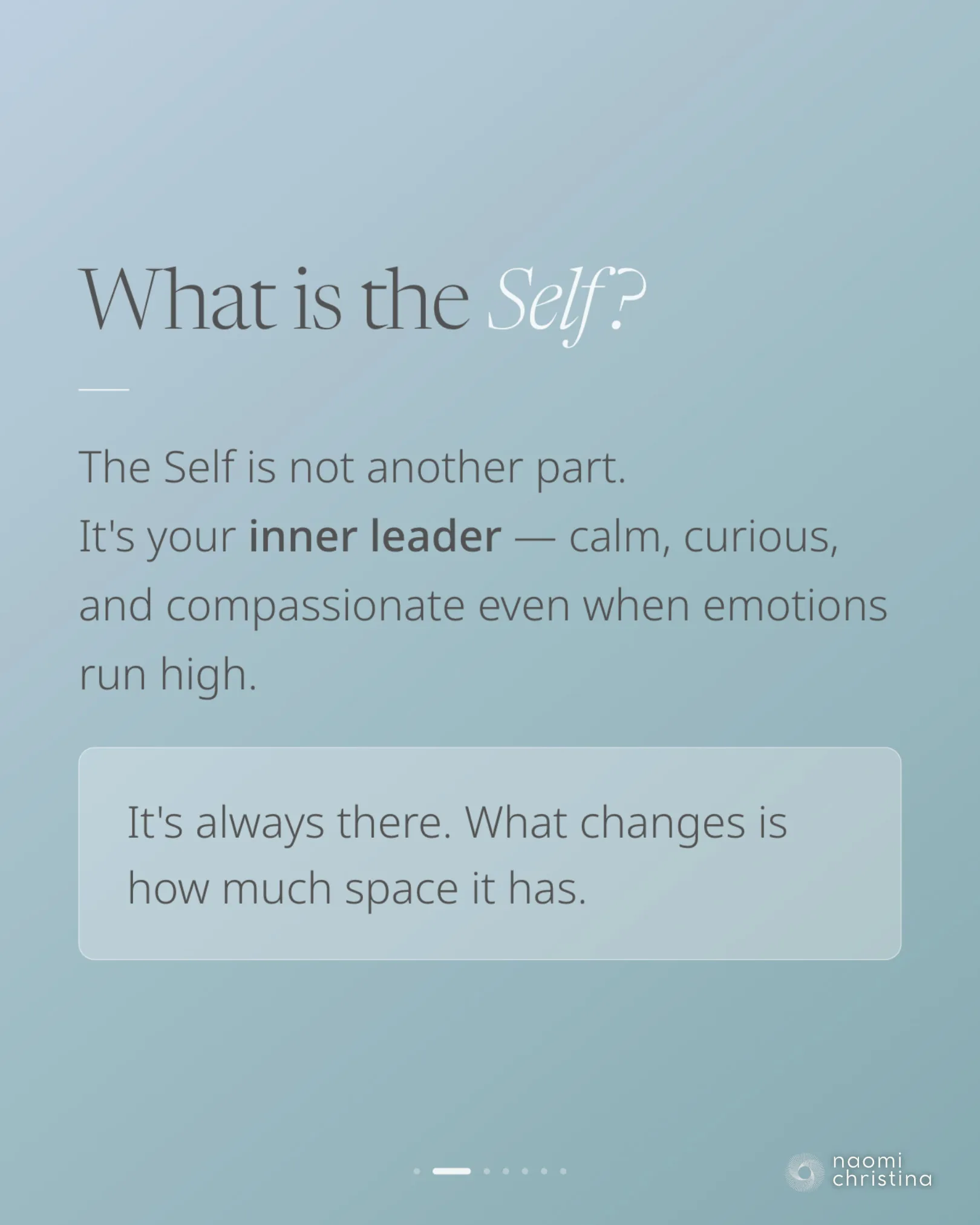
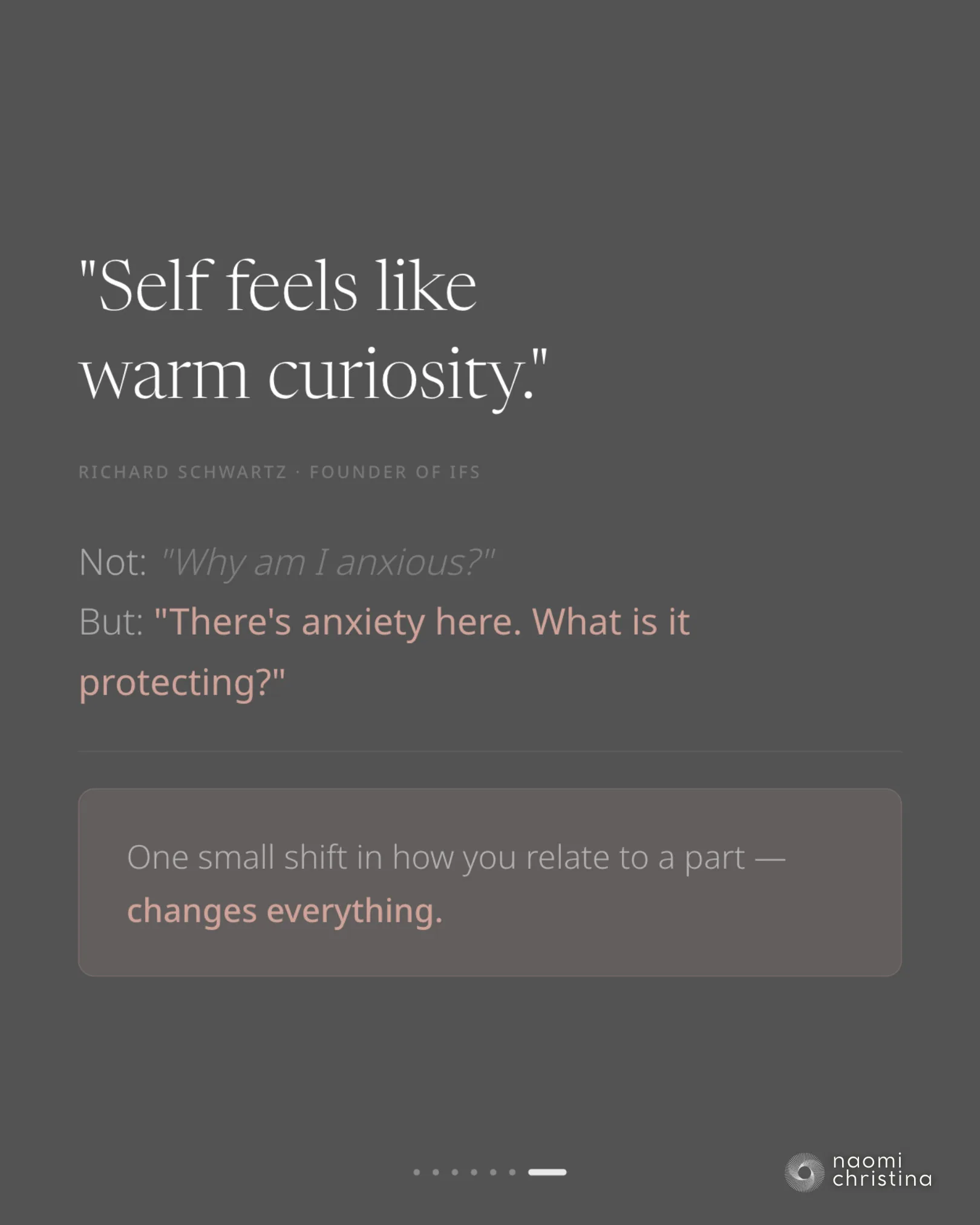
A calm, compassionate and curious presence that can notice what is happening without being completely swept away by it.
In IFS, this is called the Self.
Other traditions use different words. Mindfulness often speaks of awareness. Some spiritual traditions refer to inner wisdom, true nature, or essence. The language differs, but many people recognize the experience.
Perhaps you've felt it while walking in nature. Swimming in open water. Holding a child. Meditating. Or during a moment when you felt completely present and at ease.
Not because life was perfect. But because nothing inside you was fighting with reality.
The Self isn't something you create. It's not something you achieve through enough therapy, meditation, or self-development. It's already there. What changes is how much space it has.
When the Self is present, difficult emotions don't necessarily disappear. The inner critic may still have something to say.
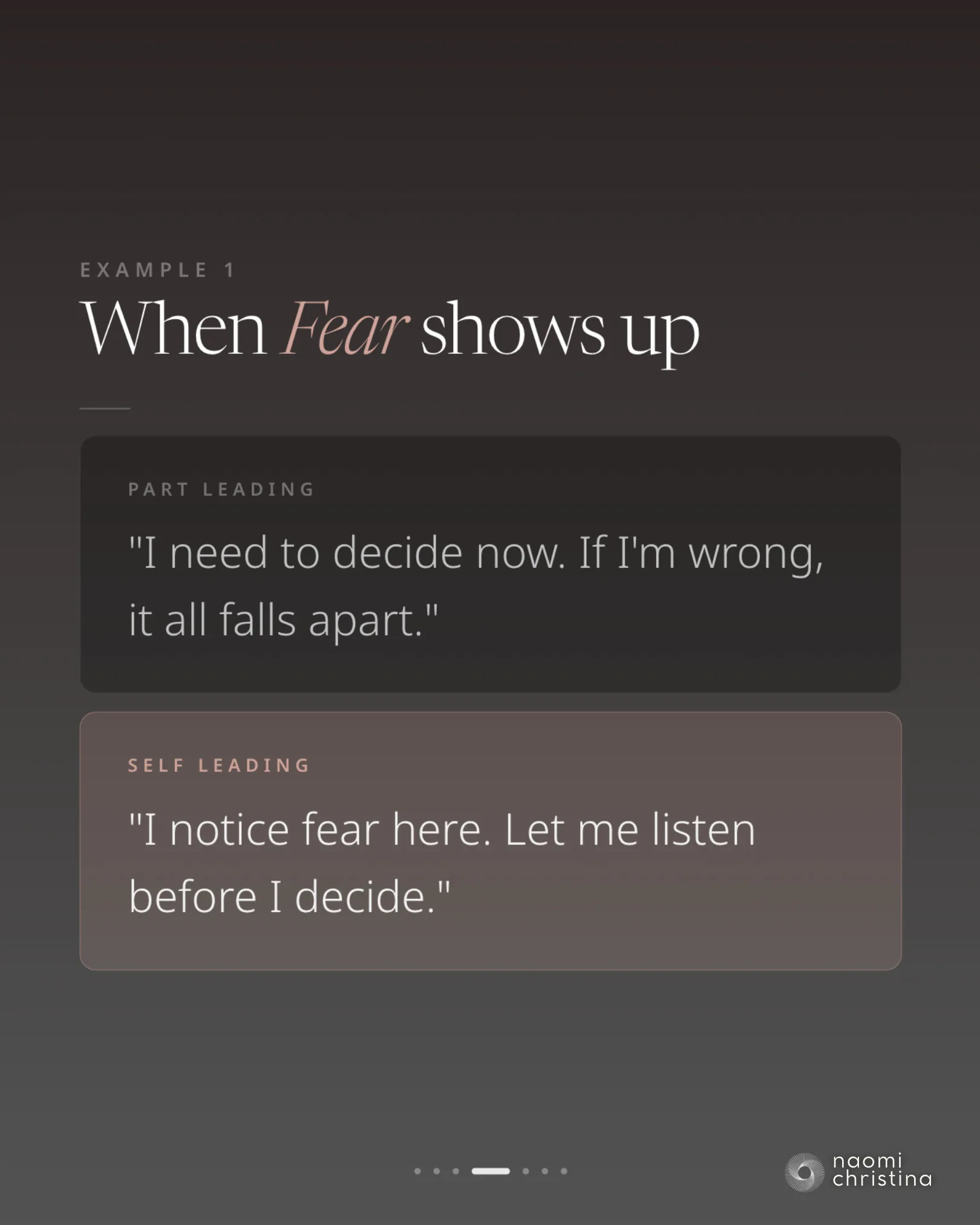
Fear may still arise. Sadness may still be present. But instead of being completely identified with these parts, we can become curious about them.
We might find ourselves thinking: "I wonder what this part is trying to protect." Instead of: "What's wrong with me?"
In my work, people often recognize Self-led moments only afterwards. They'll say: "I don't know what happened. I just responded differently than I normally would." Less judgment. More curiosity. More perspective. More choice. That noticing is often the beginning.
Not because the Self suddenly appeared. But because we start recognizing that it was there all along.
Can you recall a moment this week when you felt fully yourself — even if only for a few seconds?
Earth Day: Altered States and the Return to Nature
When did you last feel you belonged to nature?
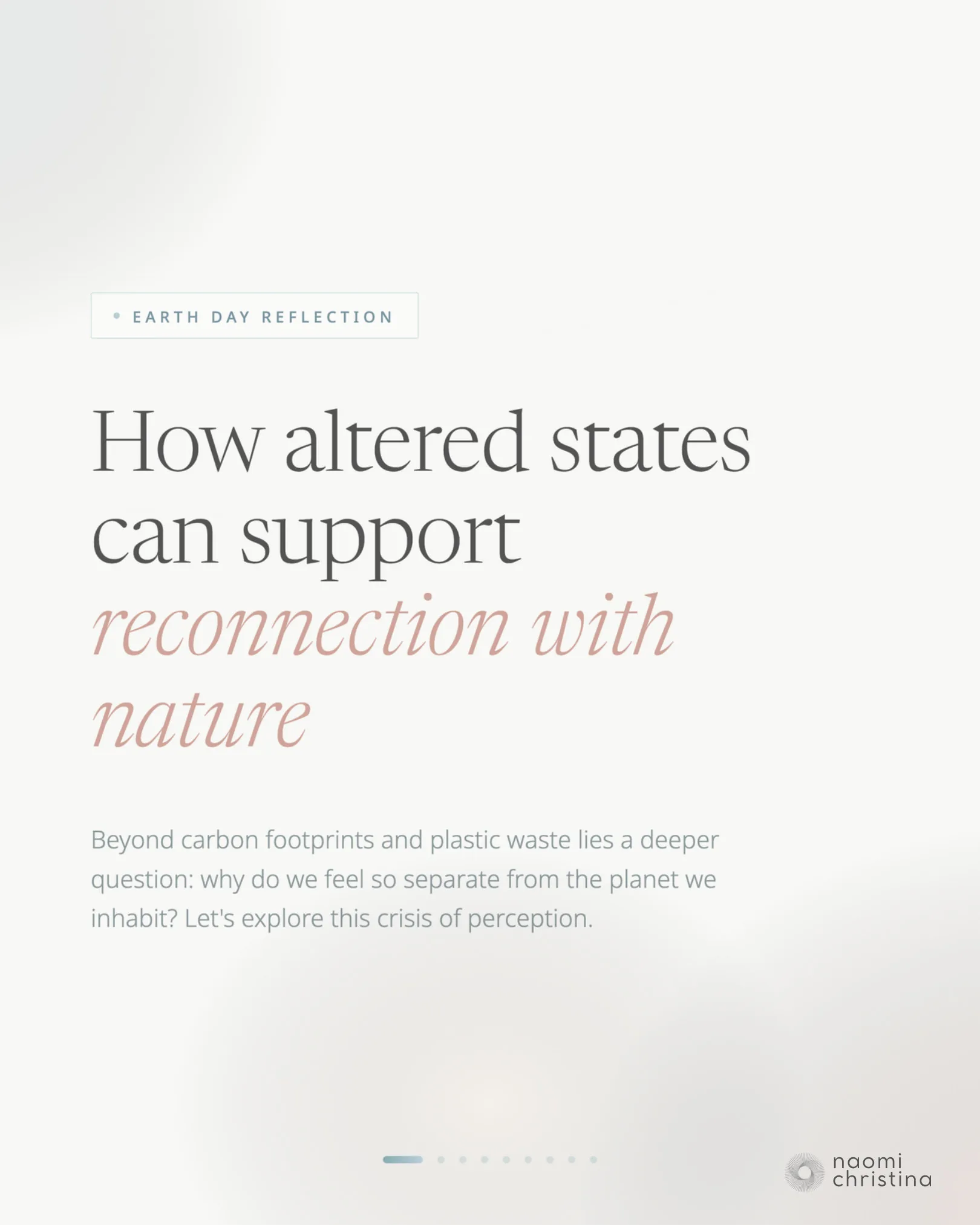
Earth Day Reflection: Altered States of Consciousness and the Return to Nature
Earth Day invites a pause, not just about our impact on the planet, but our relationship with it.
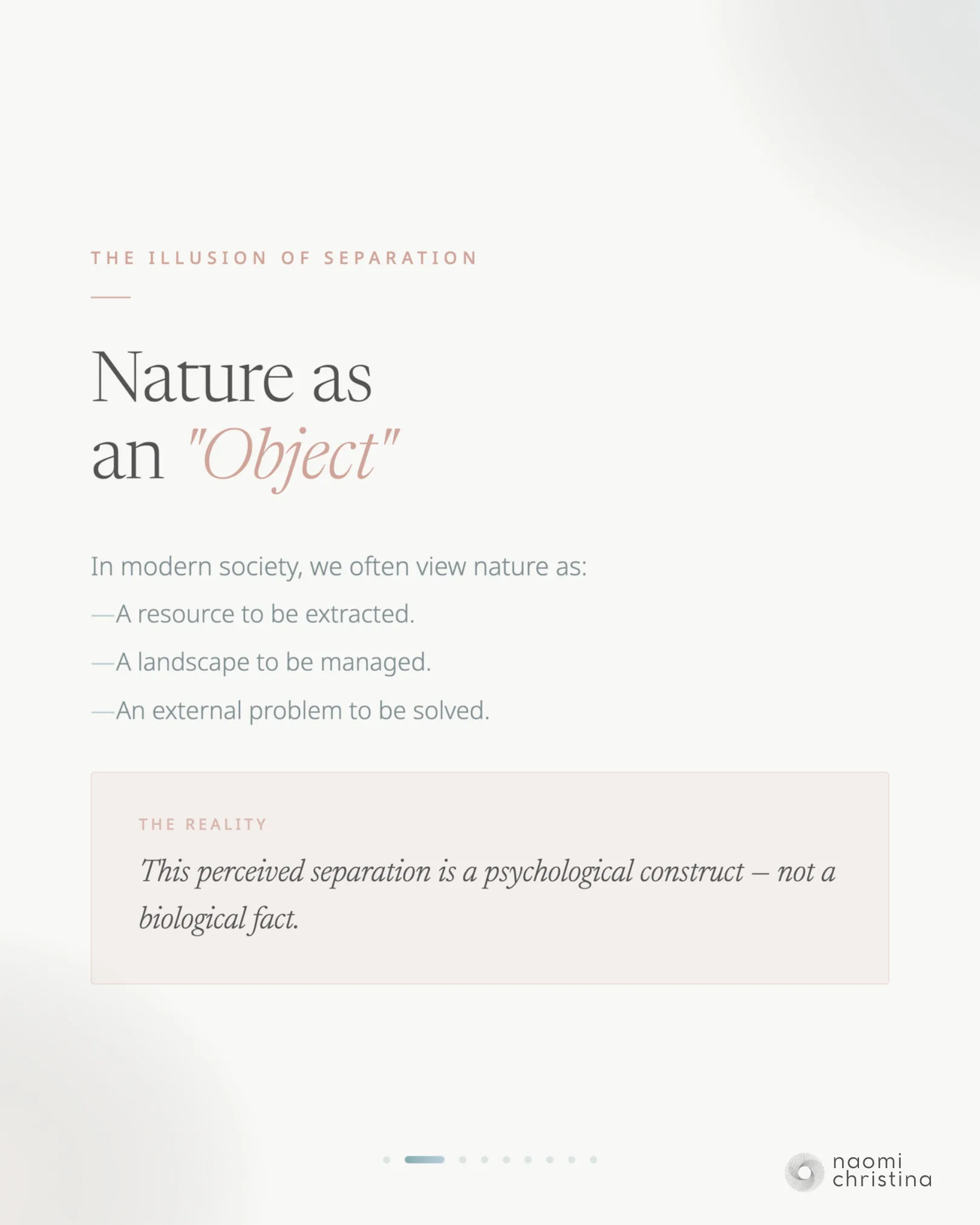
In modern industrial societies, nature tends to be framed as something external. A resource. A landscape. Something to manage.
But research suggests this separation isn't fixed.
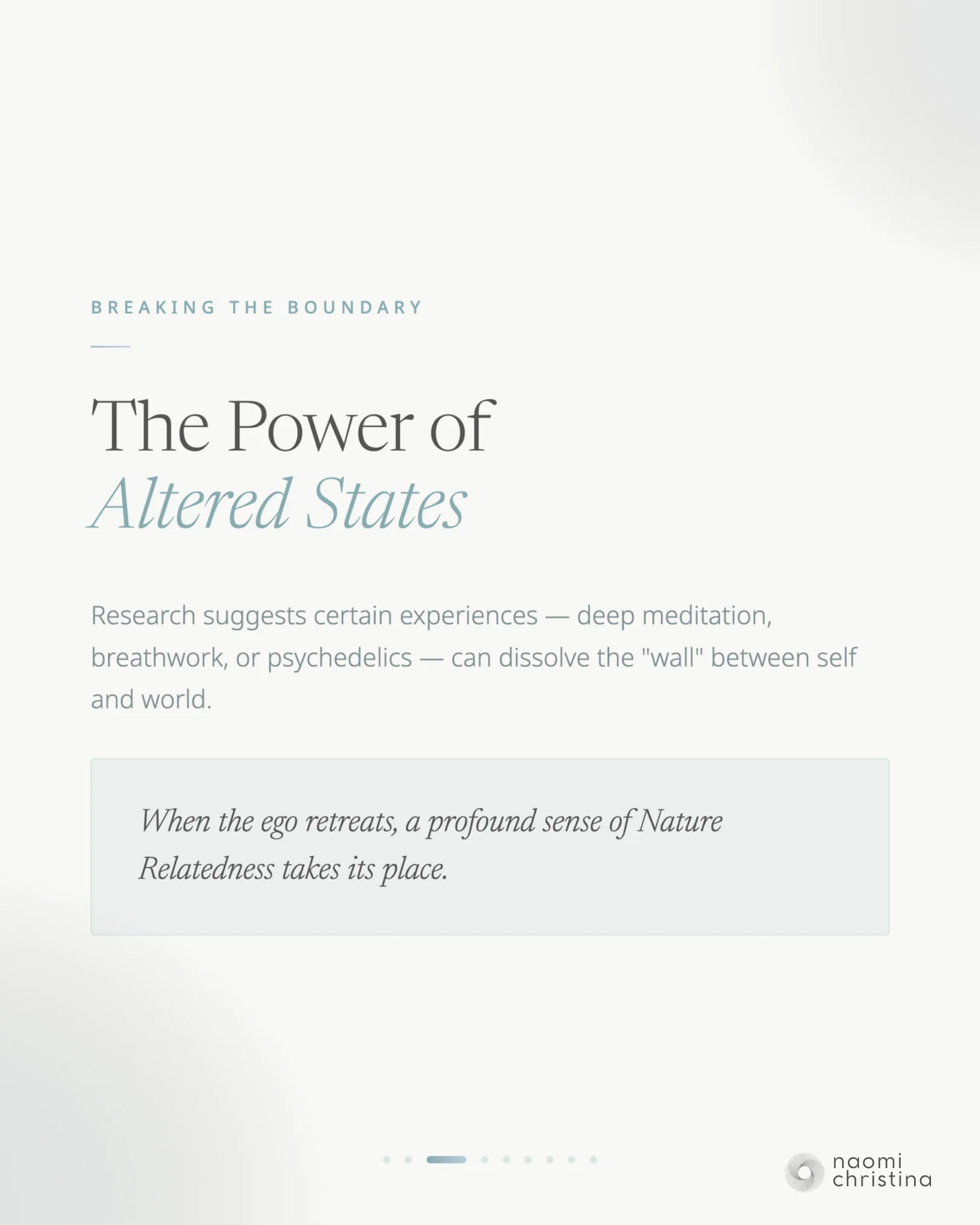
Under certain altered states - particularly those occasioned by psychedelics or deep contemplative practices - people frequently report a profound sense of reconnection with nature, with others, and with what many describe as their essence.
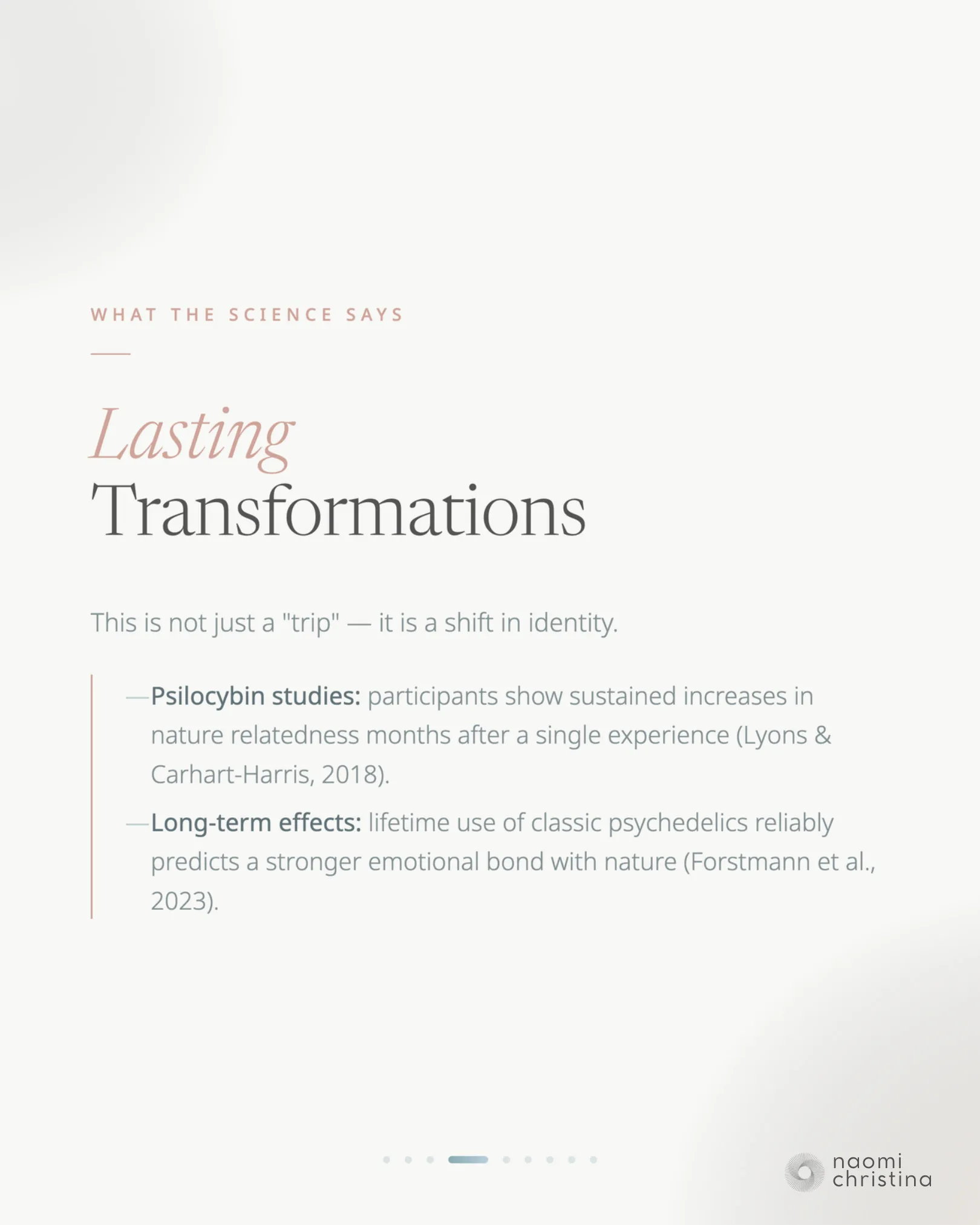
The data is consistent. Psilocybin-assisted therapy has been shown to produce sustained increases in nature relatedness, lasting months after the experience (Lyons & Carhart-Harris, 2018). Large-scale analyses confirm that lifetime use of classic psychedelics correlates with stronger feelings of connection to the natural world — psilocybin showing especially robust effects (Forstmann et al., 2023).
One proposed mechanism: ego dissolution.
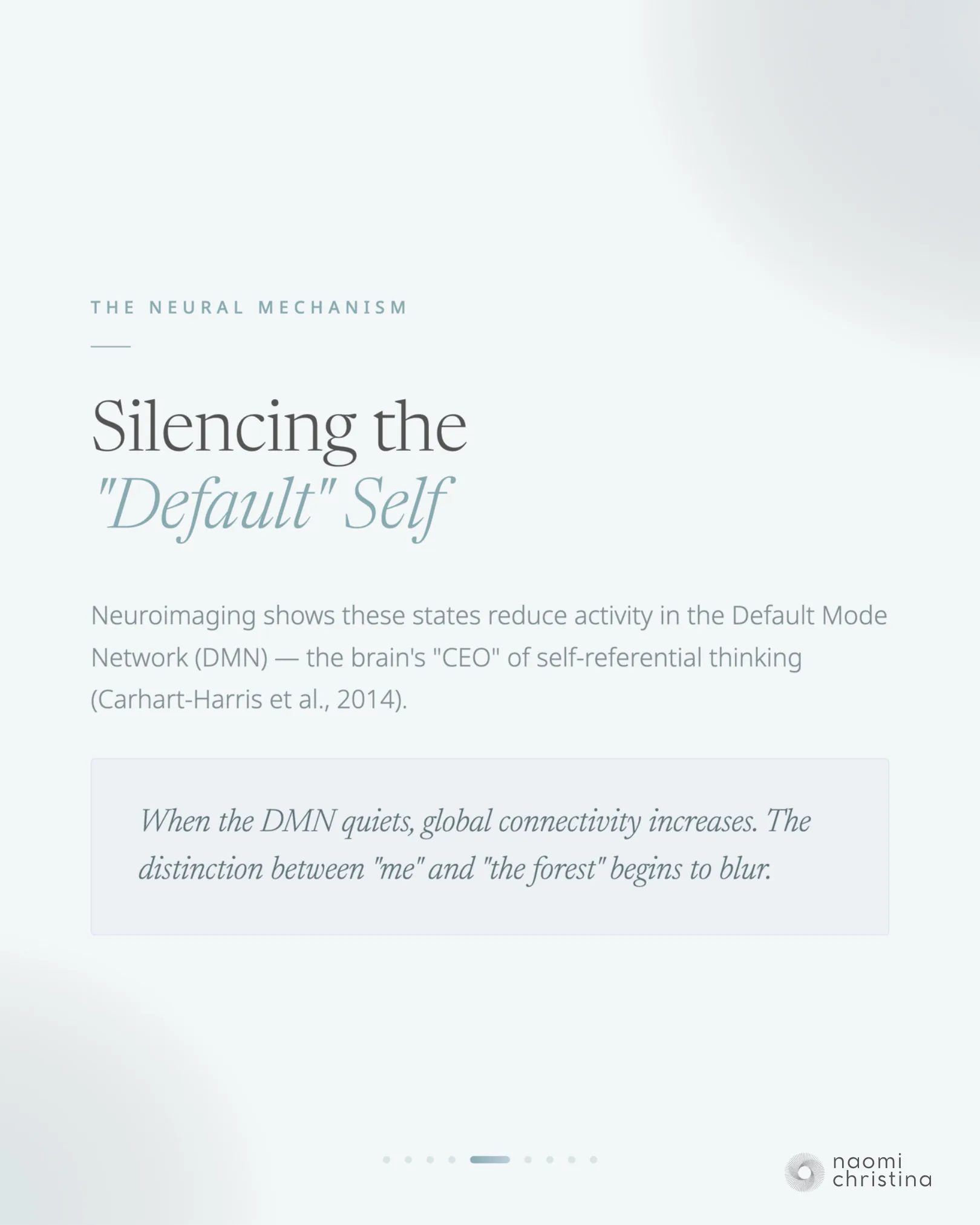
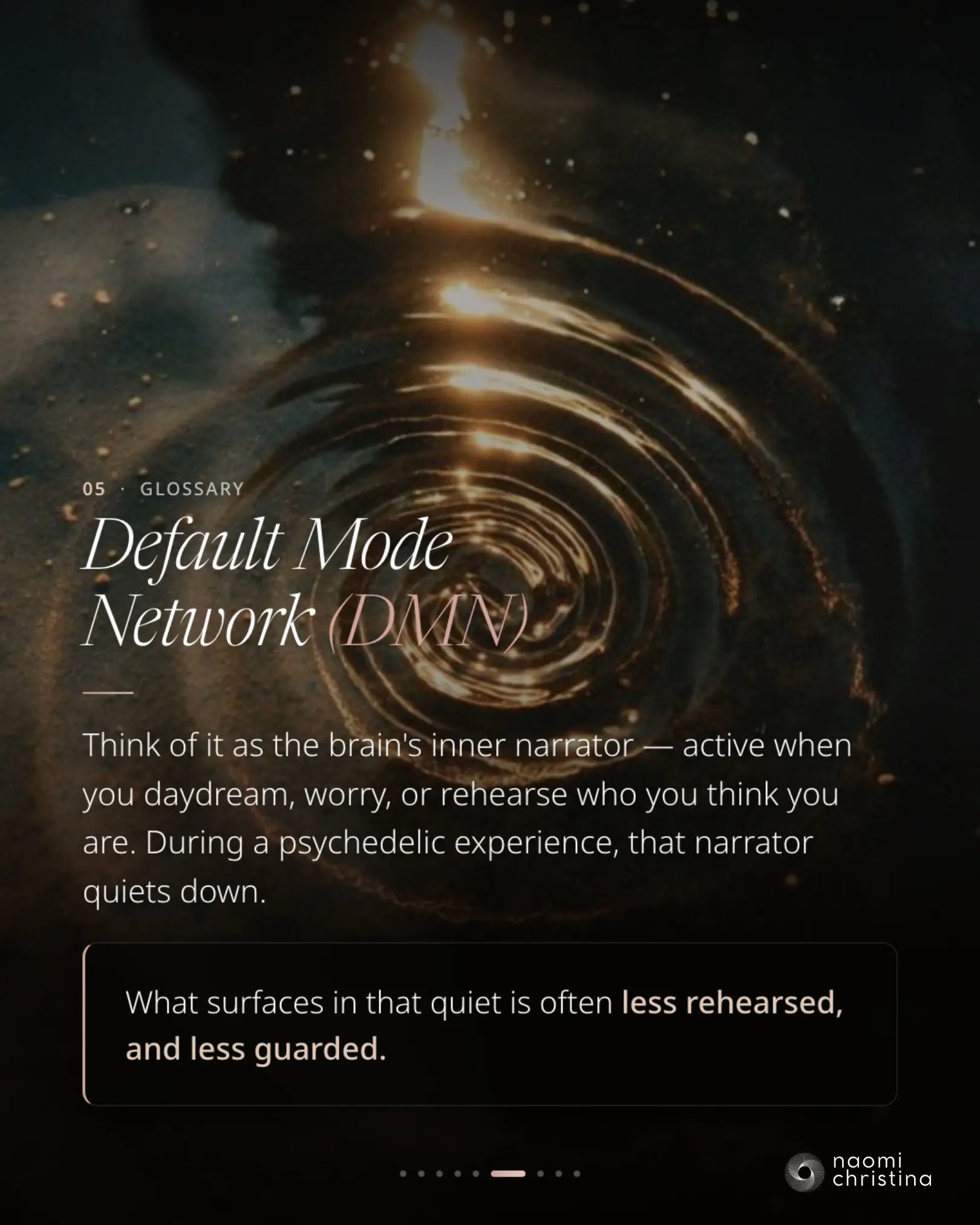
Psychedelics reduce activity in the brain's default mode network - the system associated with self-referential thinking - while increasing global connectivity (Carhart-Harris et al., 2014). The boundary between "self" and "nature" becomes less rigid. The natural world is no longer perceived as an external object, but as an extension of one's own being.
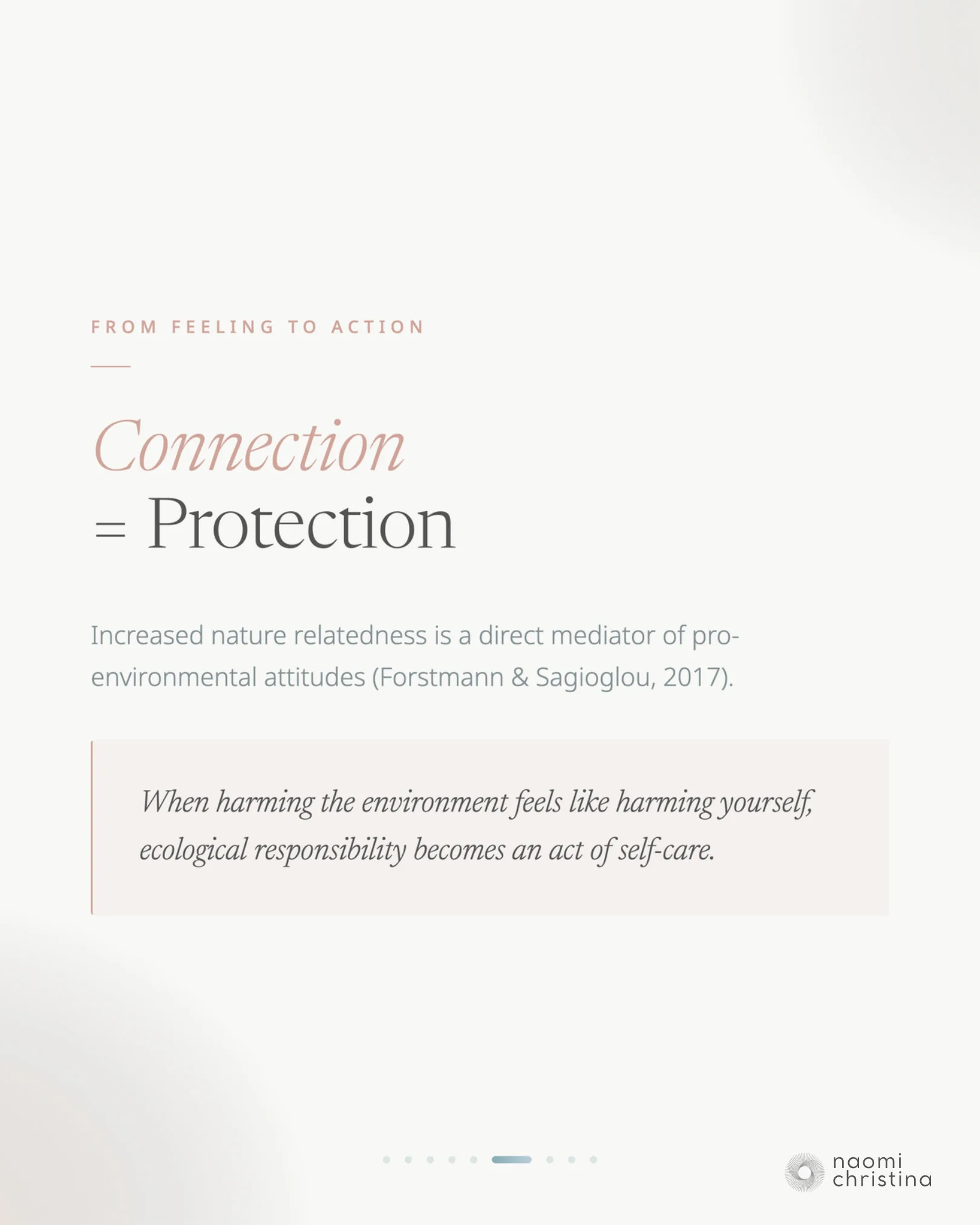
This shift has behavioral weight. Increased nature relatedness has been shown to mediate pro-environmental attitudes and actions - suggesting that ecological responsibility may arise not only from knowledge or moral obligation, but from a transformed sense of identity (Forstmann & Sagioglou, 2017).
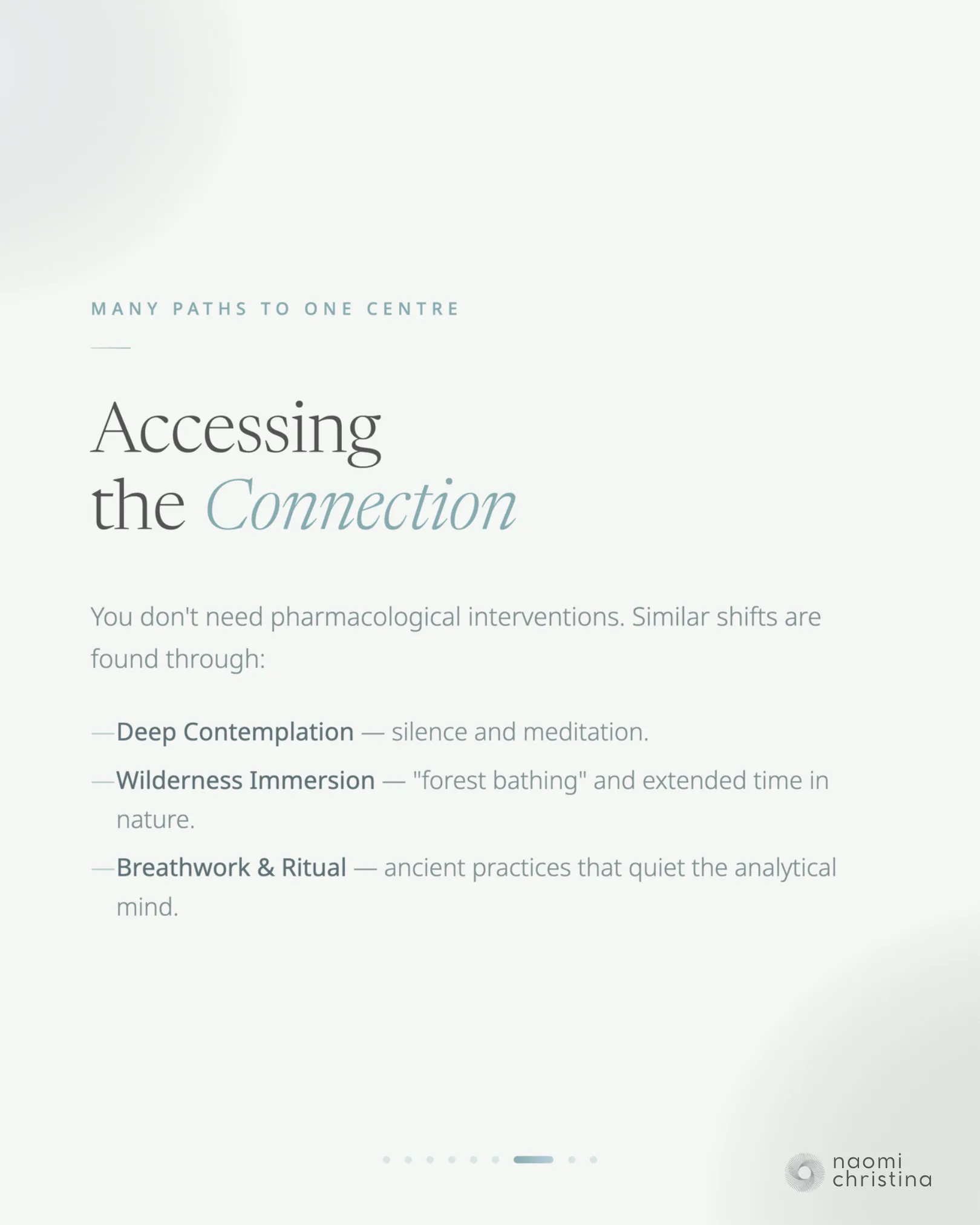
And this isn't limited to pharmacology. Meditation, wilderness immersion, breathwork, ritual - these pathways share a capacity to quiet habitual perception and open space for a more relational way of being.
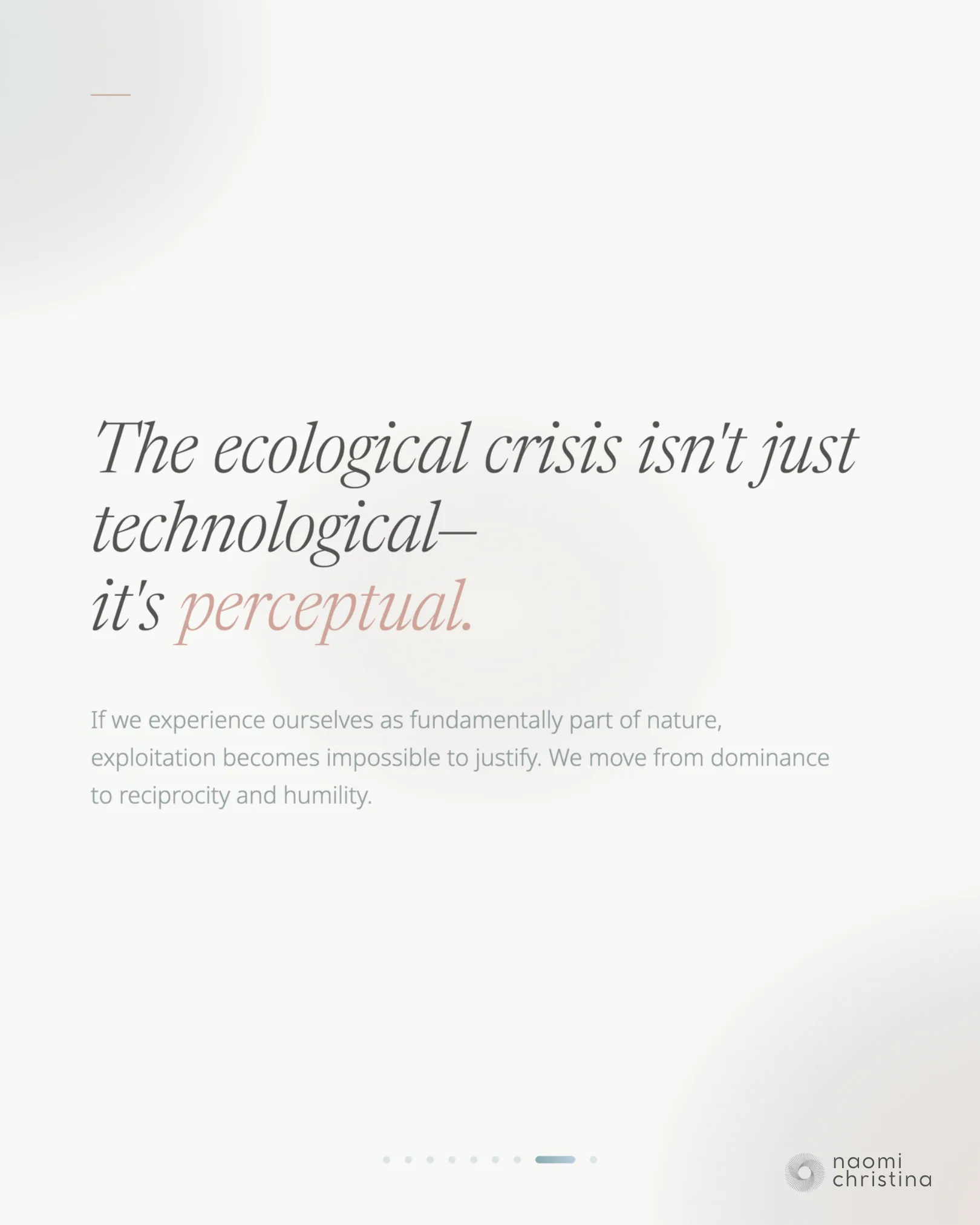
Perhaps the ecological crisis is also a perceptual one.
If we experience ourselves as fundamentally separate from nature, exploitation becomes easier to justify. But when that boundary dissolves - even briefly - a different orientation becomes possible. One rooted in reciprocity, humility, and care.
Reconnecting with nature may not require finding something new.
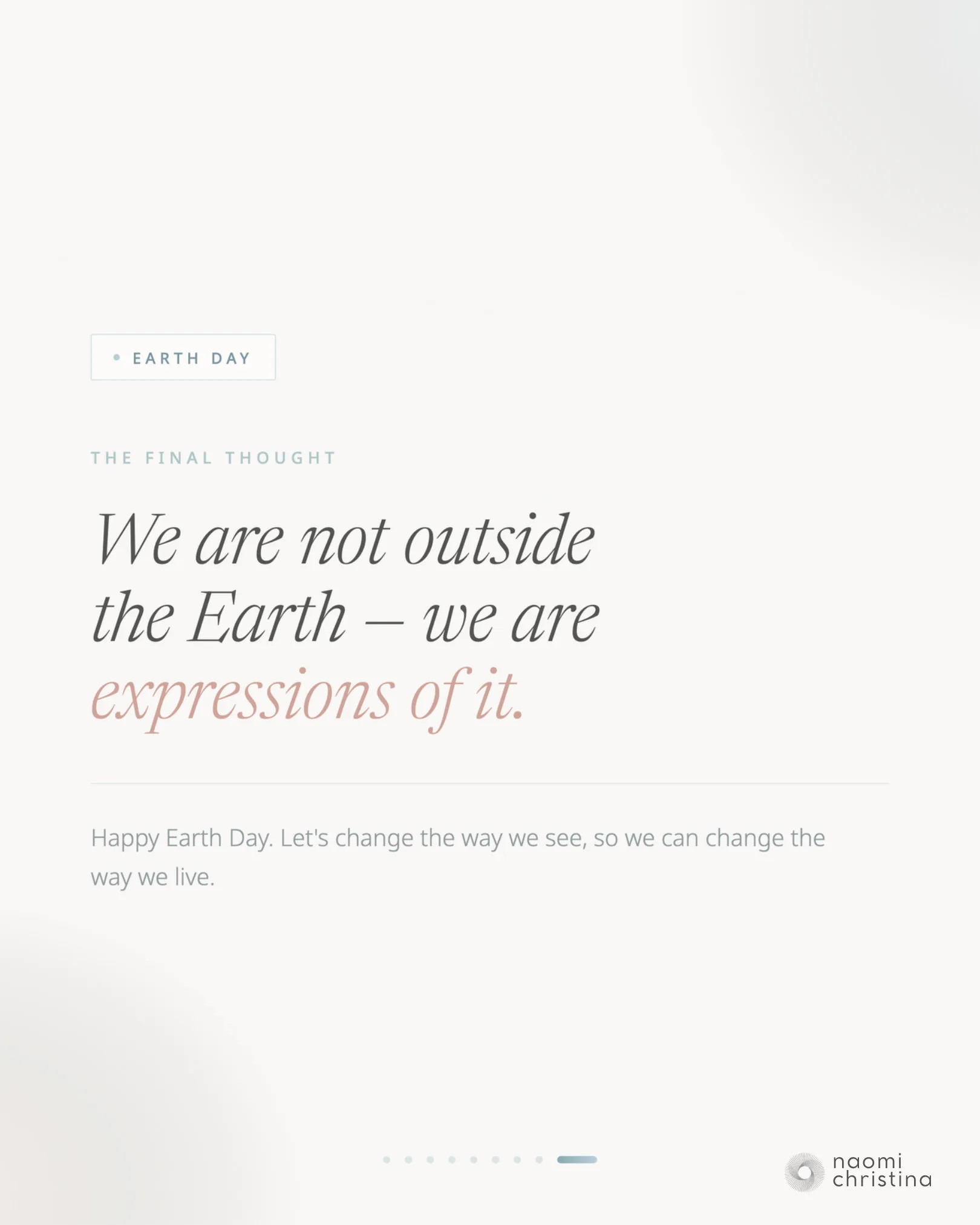
It may simply be a remembering: we are not outside the Earth. We are expressions of it.
What moment made you feel, even briefly, that you were part of something much larger than yourself?
- Carhart-Harris, R. L., Erritzoe, D., Williams, T., Stone, J. M., Reed, L. J., Colasanti, A., … & Nutt, D. J. (2014). The entropic brain: A theory of conscious states informed by neuroimaging research with psychedelic drugs. Frontiers in Human Neuroscience, 8, 20.
- Forstmann, M., Kettner, H. S., Sagioglou, C., Irvine, A., Gandy, S., Carhart-Harris, R. L., & Luke, D. (2023). Among psychedelic-experienced users, only past use of psilocybin reliably predicts nature relatedness. Journal of Psychopharmacology, 37(1), 93–106.
- Forstmann, M., & Sagioglou, C. (2017). Lifetime experience with (classic) psychedelics predicts pro-environmental behavior through an increase in nature relatedness. Journal of Psychopharmacology, 31(8), 975–988.
- Lyons, T., & Carhart-Harris, R. L. (2018). Increased nature relatedness and decreased authoritarian political views after psilocybin for treatment-resistant depression. Journal of Psychopharmacology, 32(7), 811–819.


Something Happens in the Body When You Stand Inside Something Vast
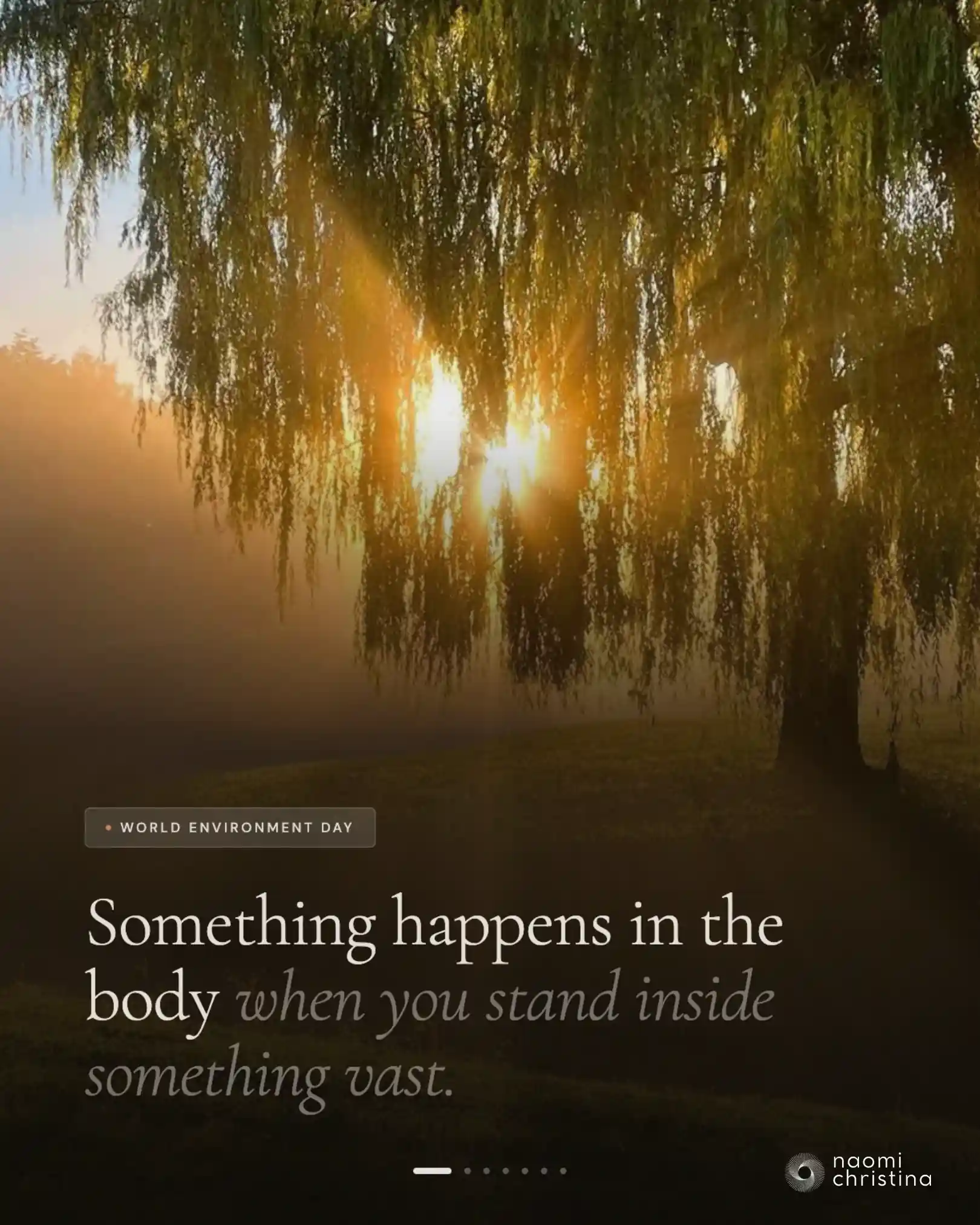
Something happens in the body when you stand inside something vast.
Before you think about it. Before you name it.
This morning, on World Environment Day, I was standing in my garden, looking out over the river. I swim there often. It is one of the places that brings me a sense of quietness. Not because I try to relax, but because something in me naturally settles.
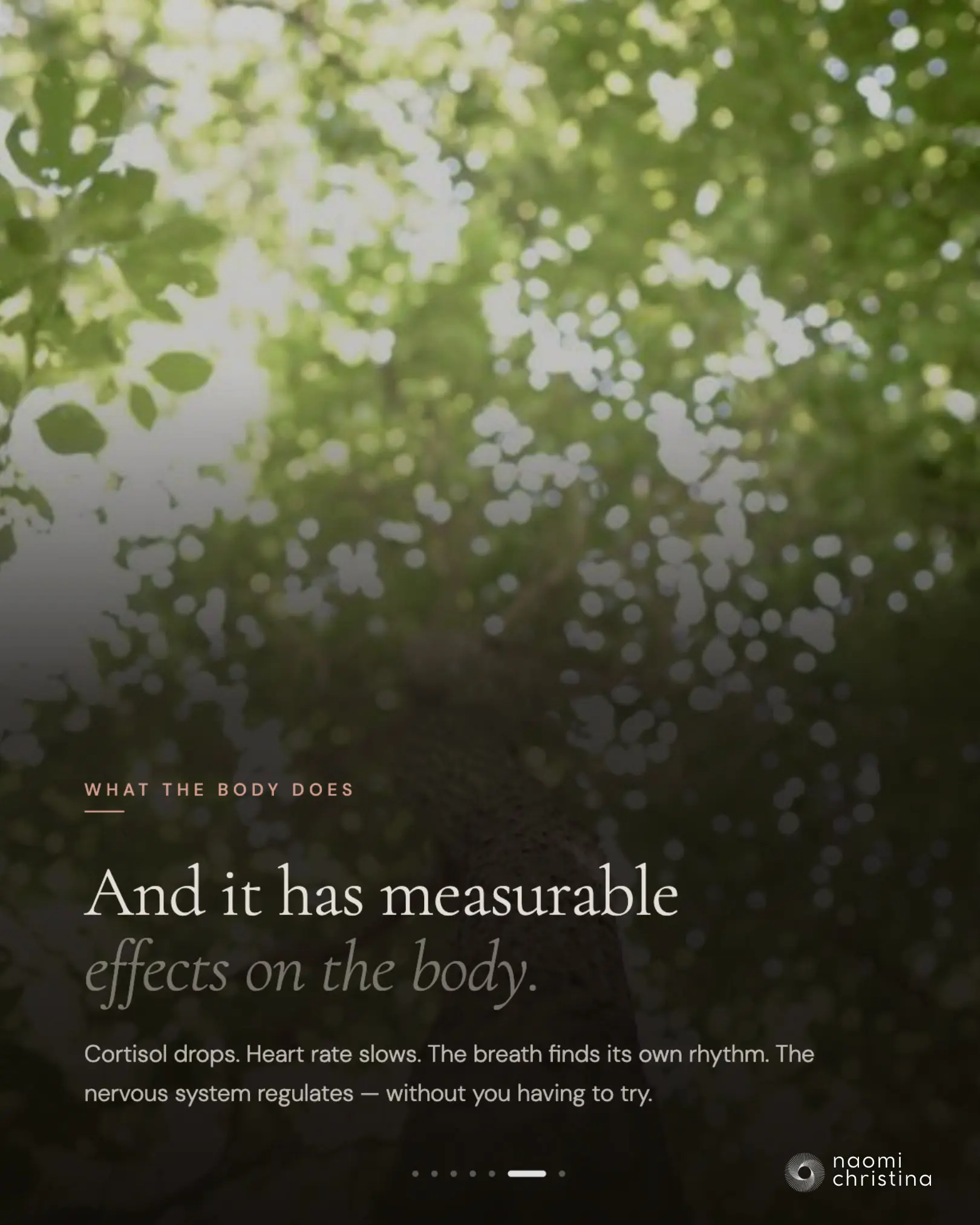
When we immerse ourselves in natural environments, something measurable shifts. Cortisol drops. Heart rate slows. The breath finds a different rhythm without us having to do anything.
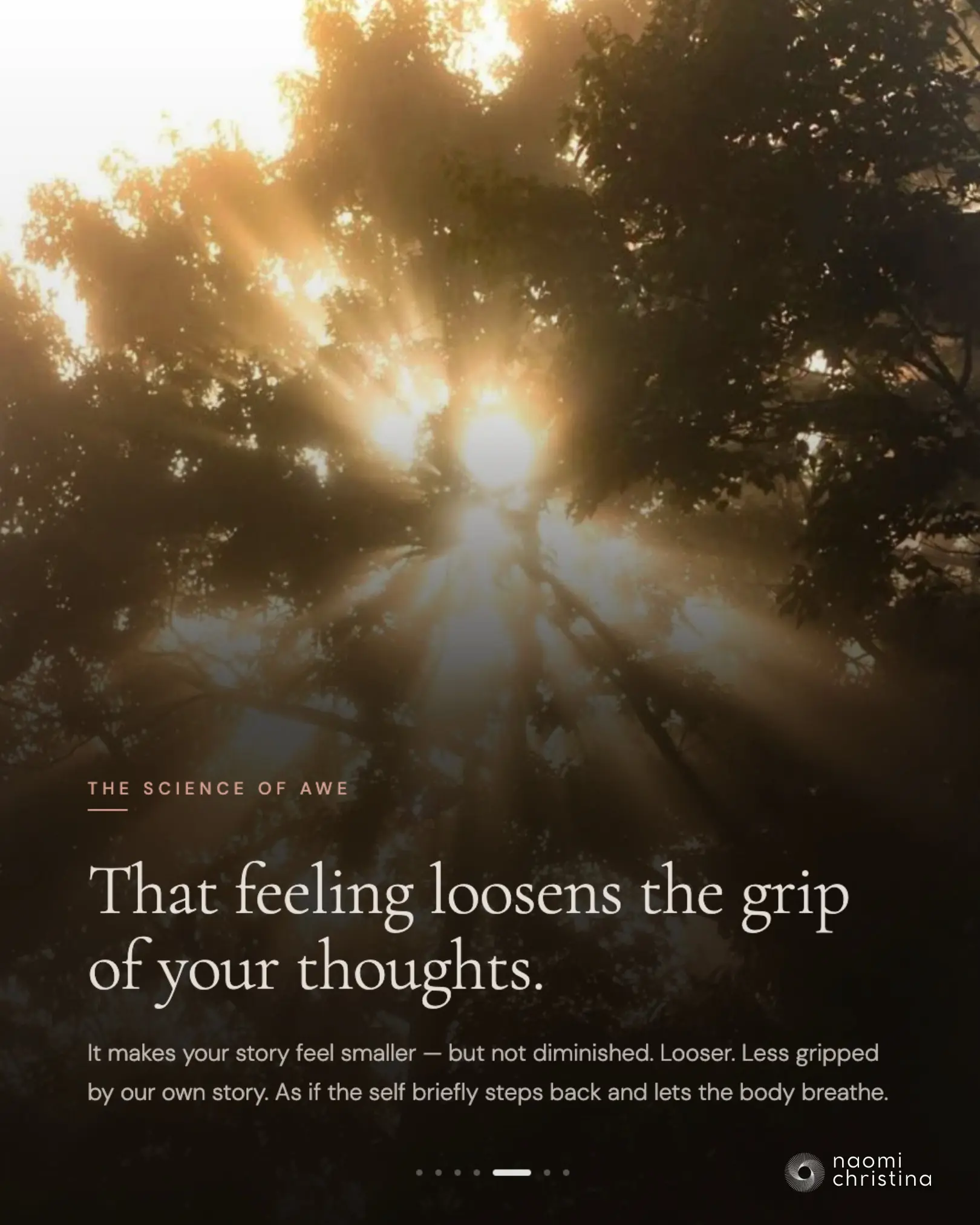
There is also something else that awe research has shown that I find quietly profound. When we stand before something vast, we often feel smaller. But not diminished. Looser. Less gripped by our own story. As if the self briefly steps back and life becomes a little bigger than our worries.
We often speak about co-regulation as something that happens between people. But a forest, birdsong, an open sky, a flowing river - these can be co-regulators too.
Perhaps this is one reason why caring for nature matters. Not only because nature needs our protection, but because we need nature too.
Today, if you can, step outside. Stand in something larger than your thoughts. And notice what happens when you no longer have to carry everything on your own.
When was the last time you let the natural world hold you?
- Piff, P. K., Dietze, P., Feinberg, M., Stancato, D. M., & Keltner, D. (2015). Awe, the small self, and prosocial behavior. Journal of Personality and Social Psychology, 108(6), 883–899.
- Park, B. J., Tsunetsugu, Y., Kasetani, T., Kagawa, T., & Miyazaki, Y. (2010). The physiological effects of Shinrin-yoku (taking in the forest atmosphere or forest bathing): Evidence from field experiments in 24 forests across Japan. Environmental Health and Preventive Medicine, 15(1), 18–26.
- Yao, W., Zhang, X., & Gong, Q. (2021). The effect of exposure to the natural environment on stress reduction: A meta-analysis. Urban Forestry & Urban Greening, 57, 126932.
Rest Is Not the Pause Before Healing
A client said something to me recently that I keep thinking about.
"I know I should rest. But every time I stop, I feel like I'm failing."
That sentence holds so much. Because we have built a culture where stillness feels like a character flaw and action has become the only language we trust for healing.
This week, Mental Health Awareness Week asks us for attention. And there is real truth in that. Showing up matters. Asking for help matters.
But I want to offer a quieter perspective. One I return to often in my work with clients.
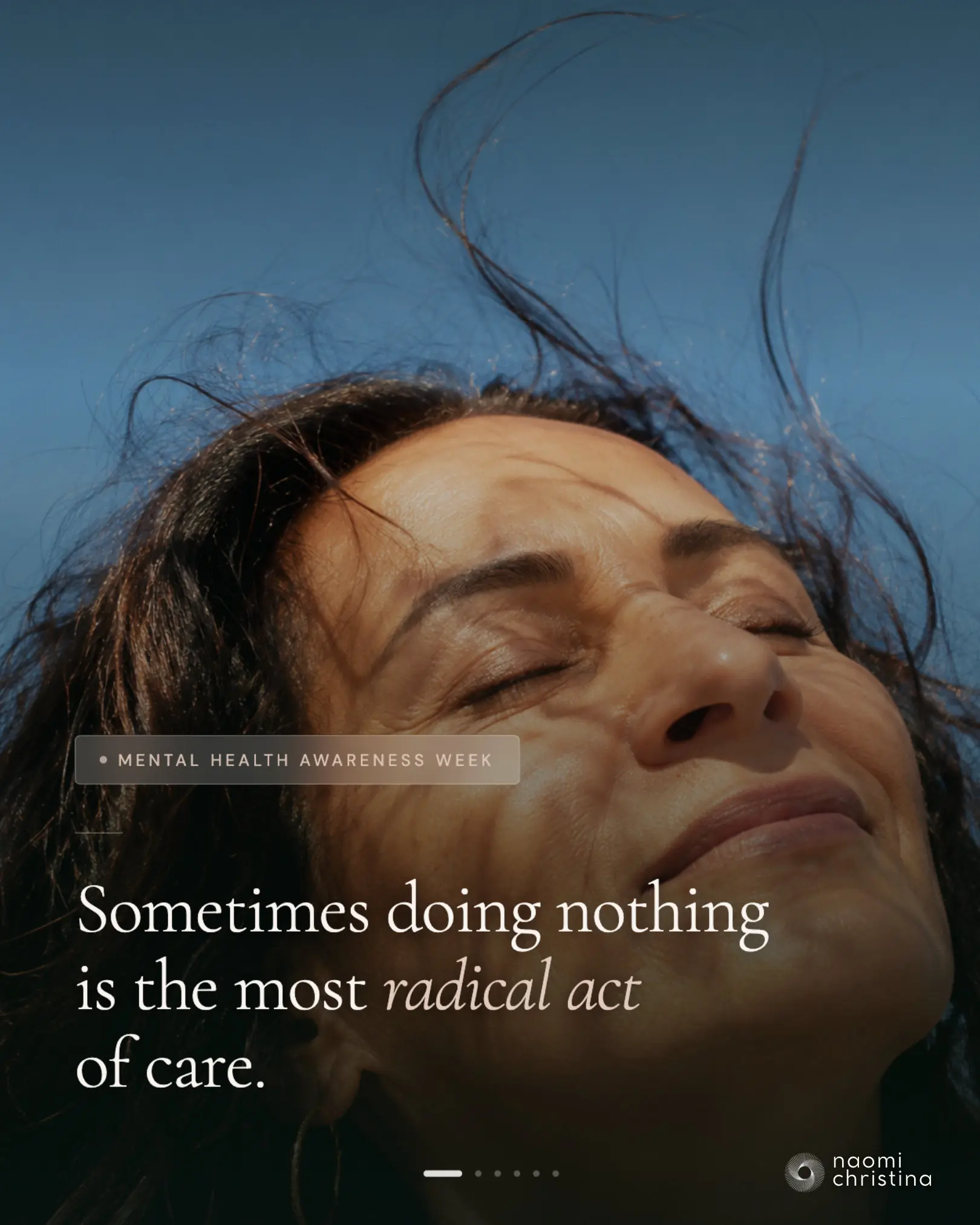
Sometimes, the most radical thing you can do is stop.
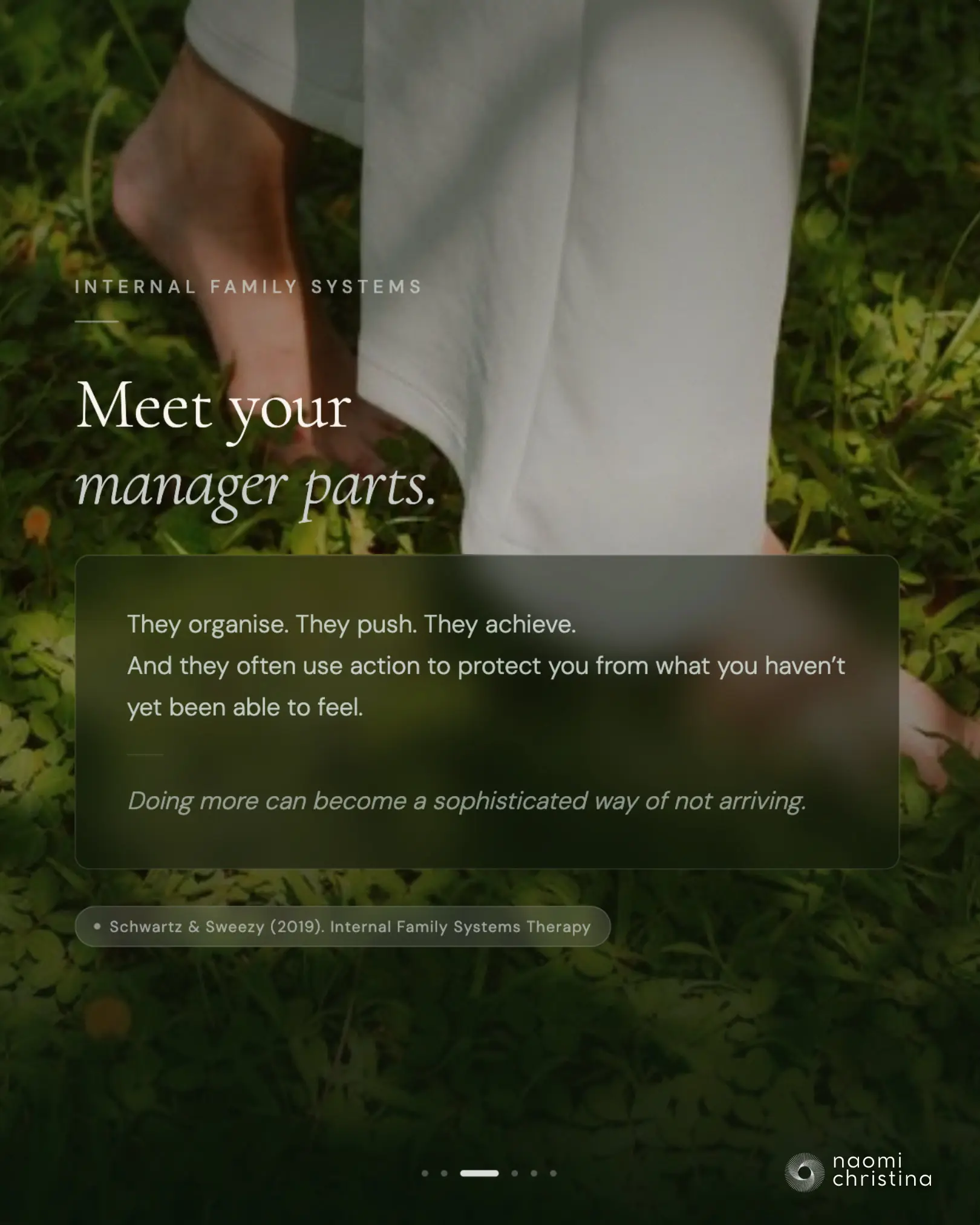
In Internal Family Systems, we work with what are called manager parts — the parts of us that organise, plan, push, and achieve. They are not wrong. Often, they developed intelligently to help us function, perform, or stay emotionally safe.
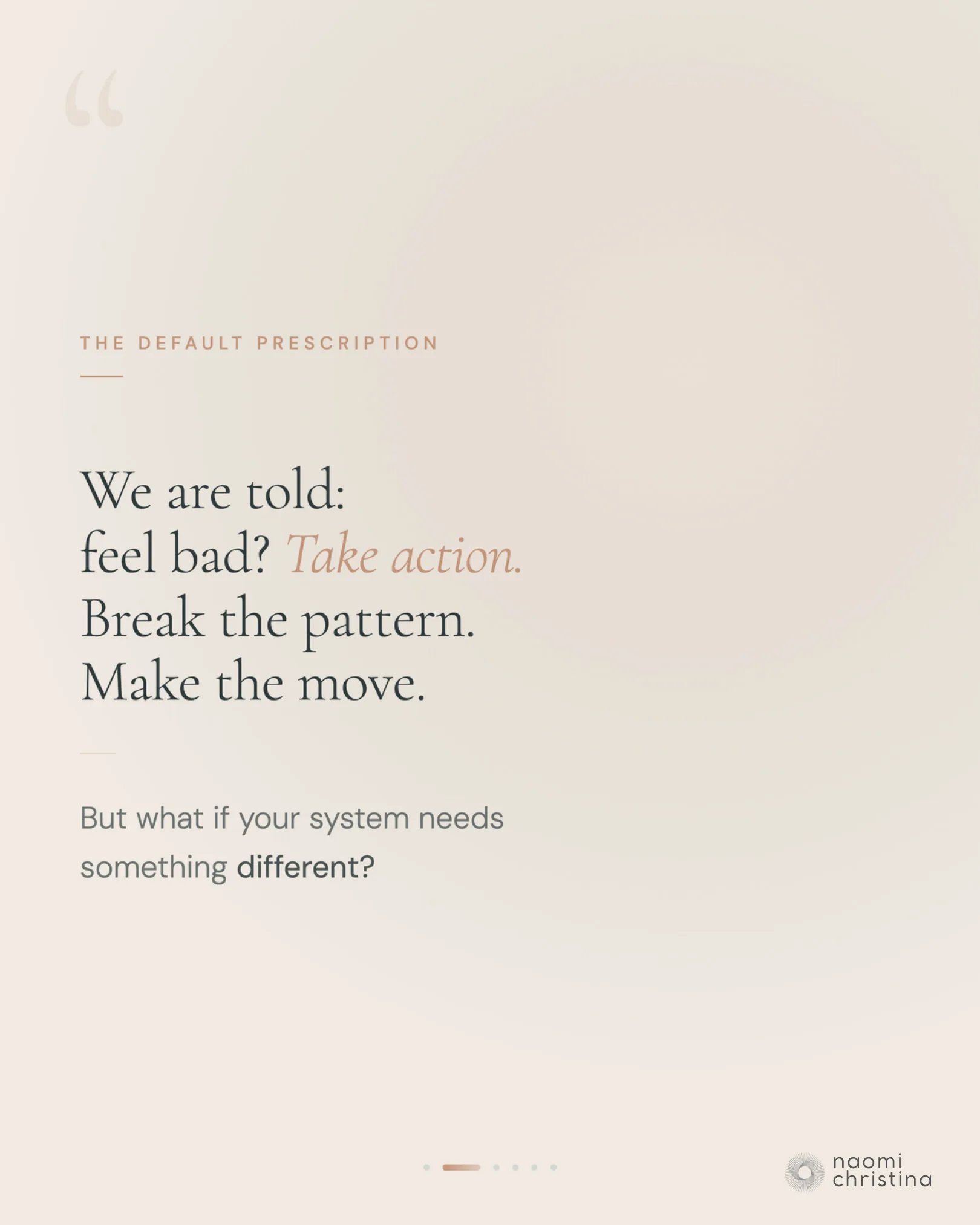
But managers can use action to keep us moving away from the very thing that needs our attention.
Doing more is sometimes the most sophisticated way of not arriving.
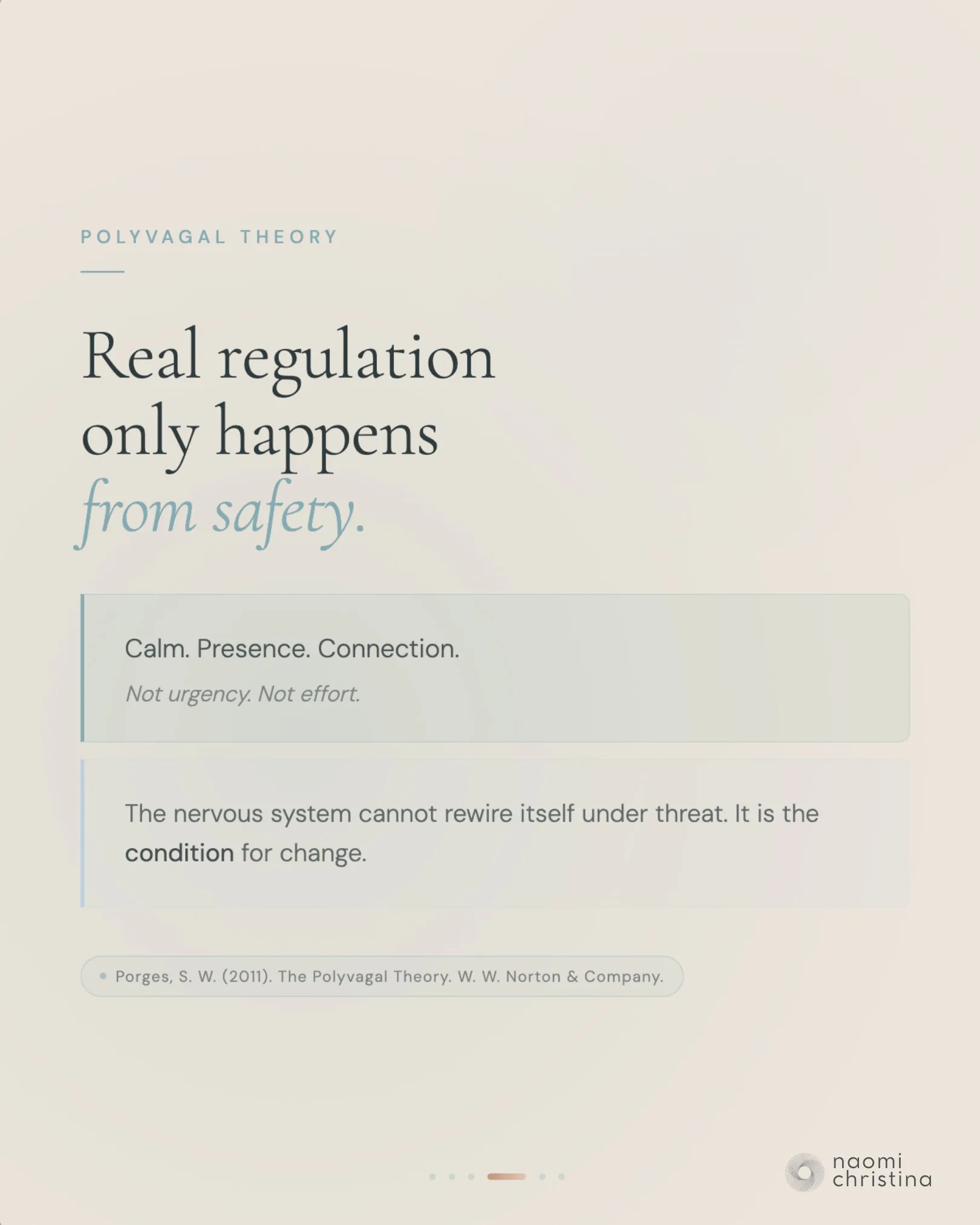
Stephen Porges' Polyvagal Theory helps us understand this at a physiological level. His research showed that genuine integration — the kind where real change becomes possible — only happens from within a state of felt safety. Calm. Presence. Not urgency, not effort, not pushing through.
Rest is not passivity. Ventral vagal regulation is an active, intelligent choice. The body already knows this — even when the mind protests.
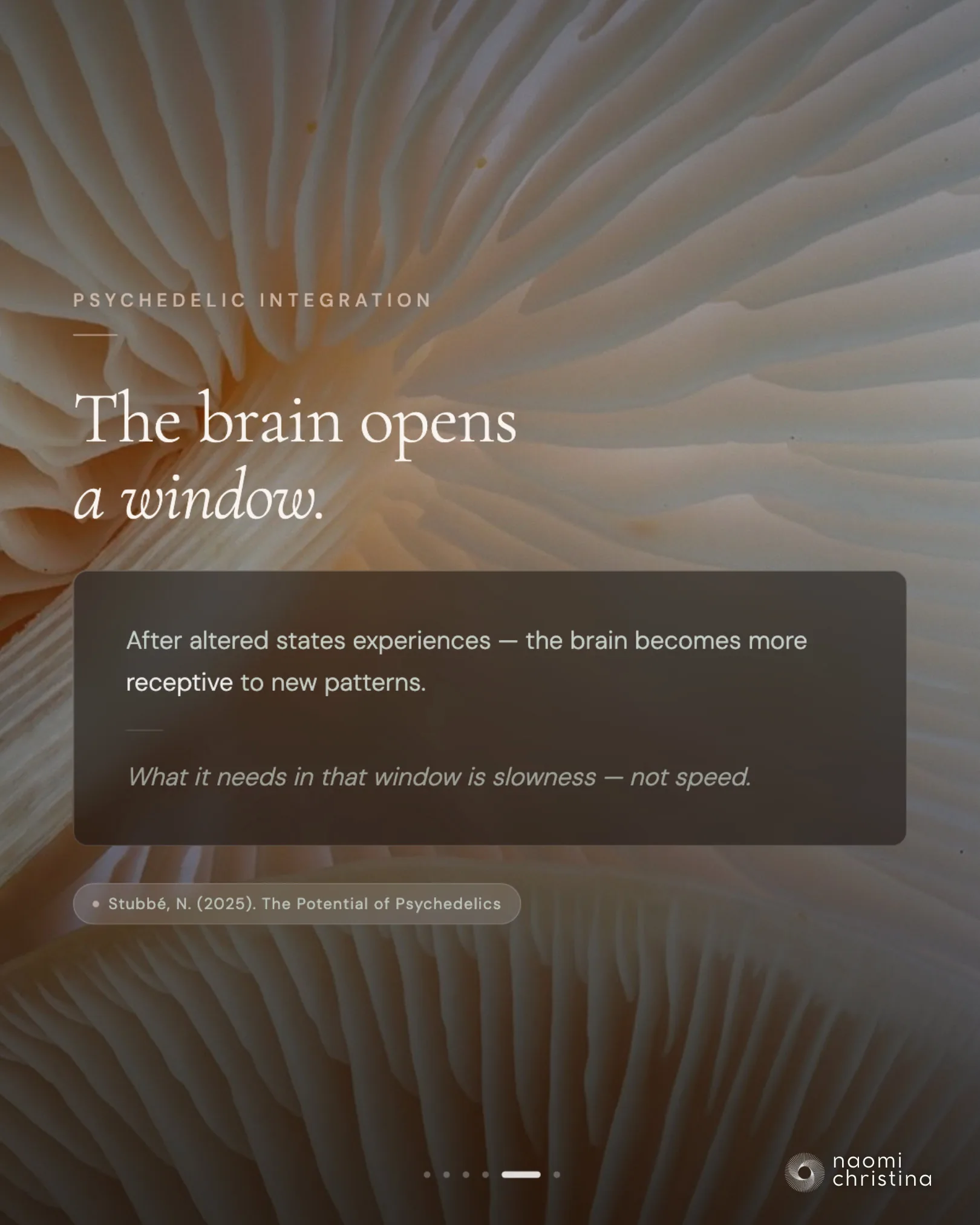
This becomes especially important after deep inner work. After emotional processing, breathwork, or psychedelic experiences, the brain enters a more receptive state. Research on neuroplasticity shows that new patterns are most available in that period. New patterns can emerge more easily then but that process often asks for slowness rather than speed.
Taking action is the culturally approved response to pain. Resting, feeling, allowing; these are harder to justify. Sometimes slowing down is the work itself.
They don't look like progress from the outside. But the inner system knows the difference.
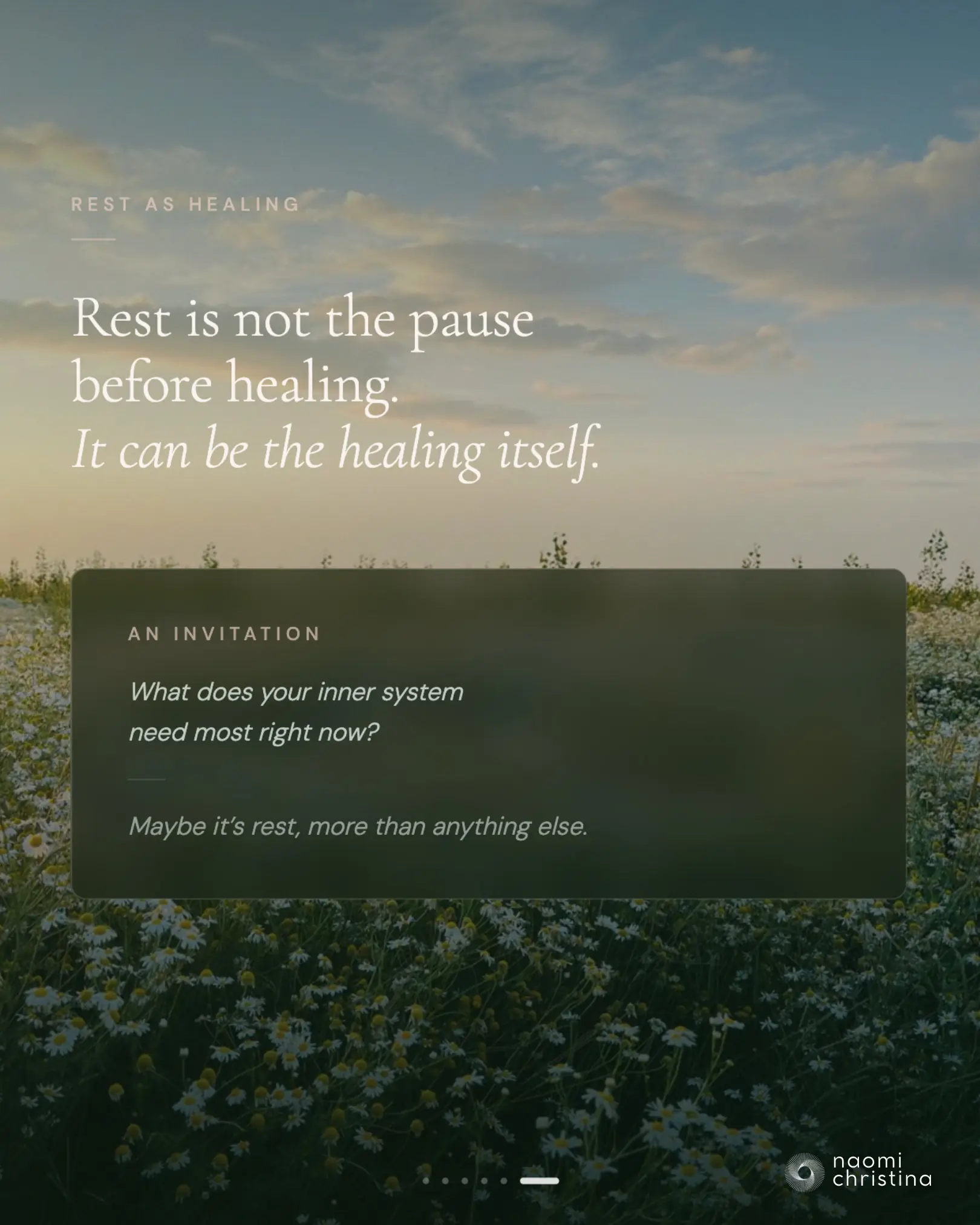
What would change if you no longer saw rest as a delay before healing, but as part of healing itself?
- Porges, S. W. (2011). The Polyvagal Theory: Neurophysiological Foundations of Emotions, Attachment, Communication, and Self-Regulation. W. W. Norton & Company.
- Schwartz, R. C., & Sweezy, M. (2019). Internal Family Systems Therapy (2nd ed.). Guilford Press.
- Stubbé, Naomi. (2025). The Potential of Psychedelics [Het potentieel van psychedelica].

A Psychedelic Glossary — It's Not the Dose
It's not the dose.
In my book, I tell the story of Ellen.
She joined a psilocybin retreat hoping for insight and openness. Instead, she found an unclear program, a large group, and everyone receiving the same high dose, regardless of what each person needed. There was no preparation beforehand. No one to help her land afterwards. And when fear took over during her journey, there wasn't really anyone there to meet it.
What should have been an opening became something she struggled with long after.
Some time later, Ellen found me.
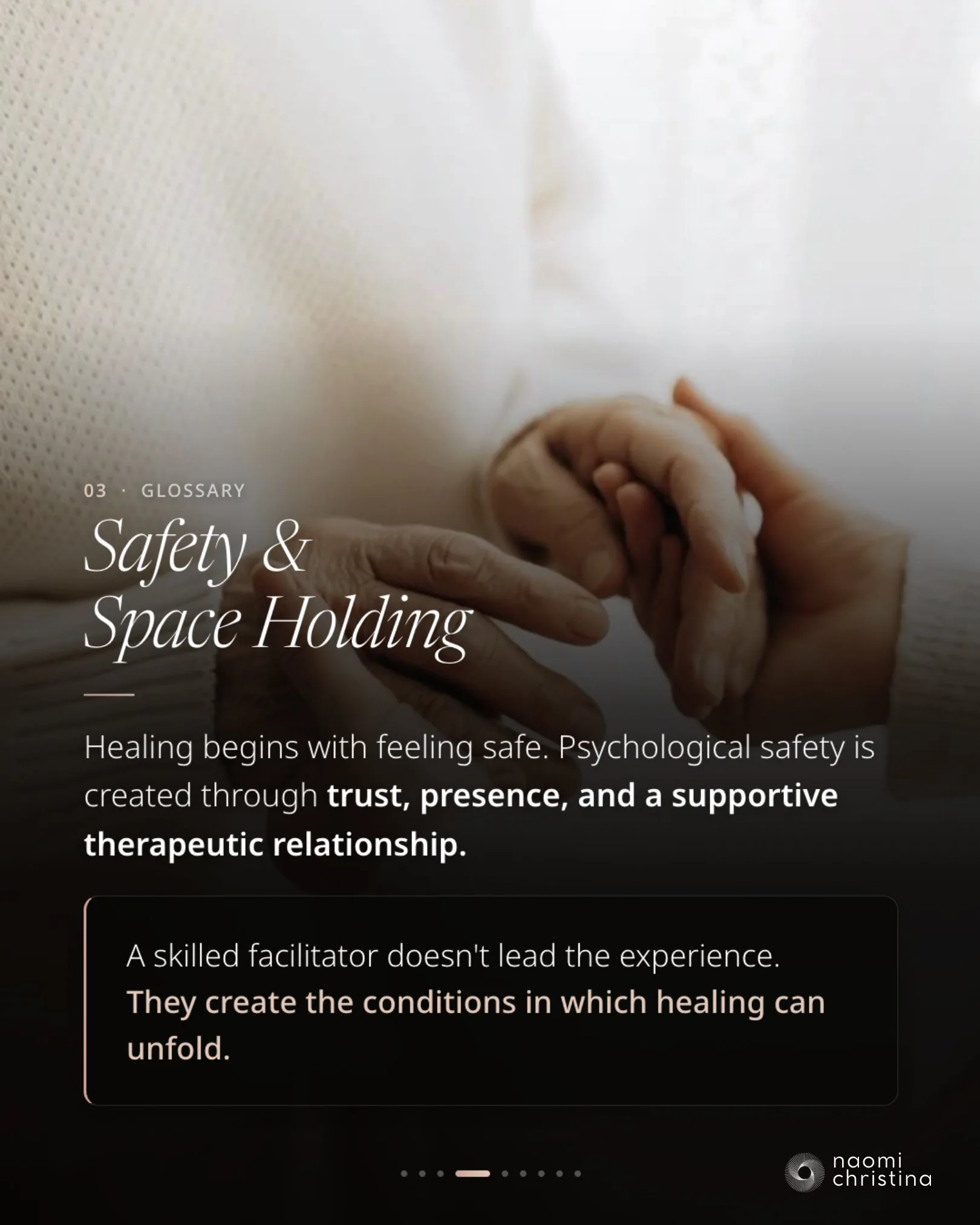
Together, we carefully revisited what had happened. Through preparation, a safe therapeutic relationship, and compassionate space holding, she was finally able to process the experience that had once overwhelmed her. What had felt like a failed journey gradually became part of her healing.
I still keep in touch with Ellen once in a while. Her story reminds me of something many people don't expect: the psilocybin truffles weren't the deciding factor. It was everything surrounding the experience.
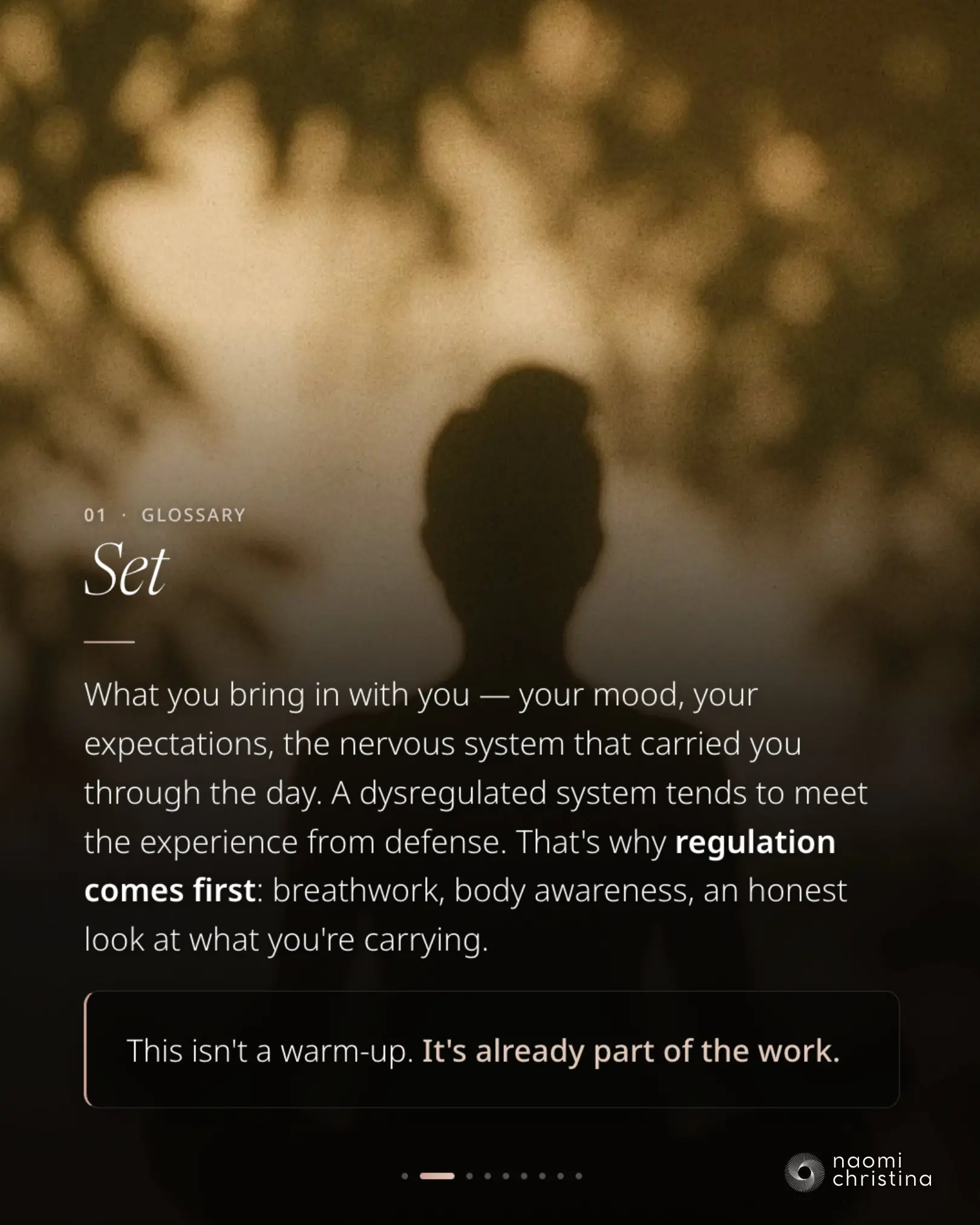
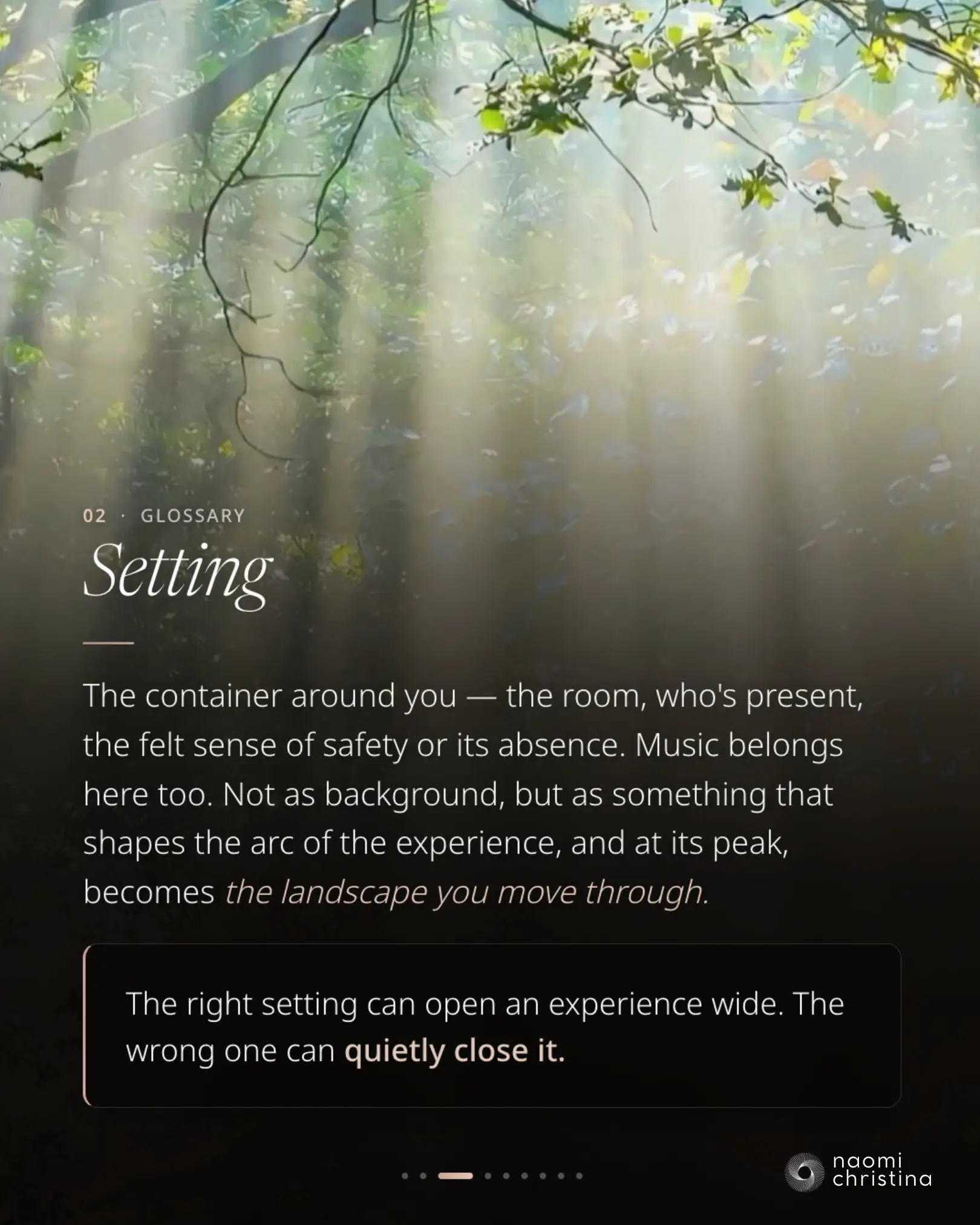
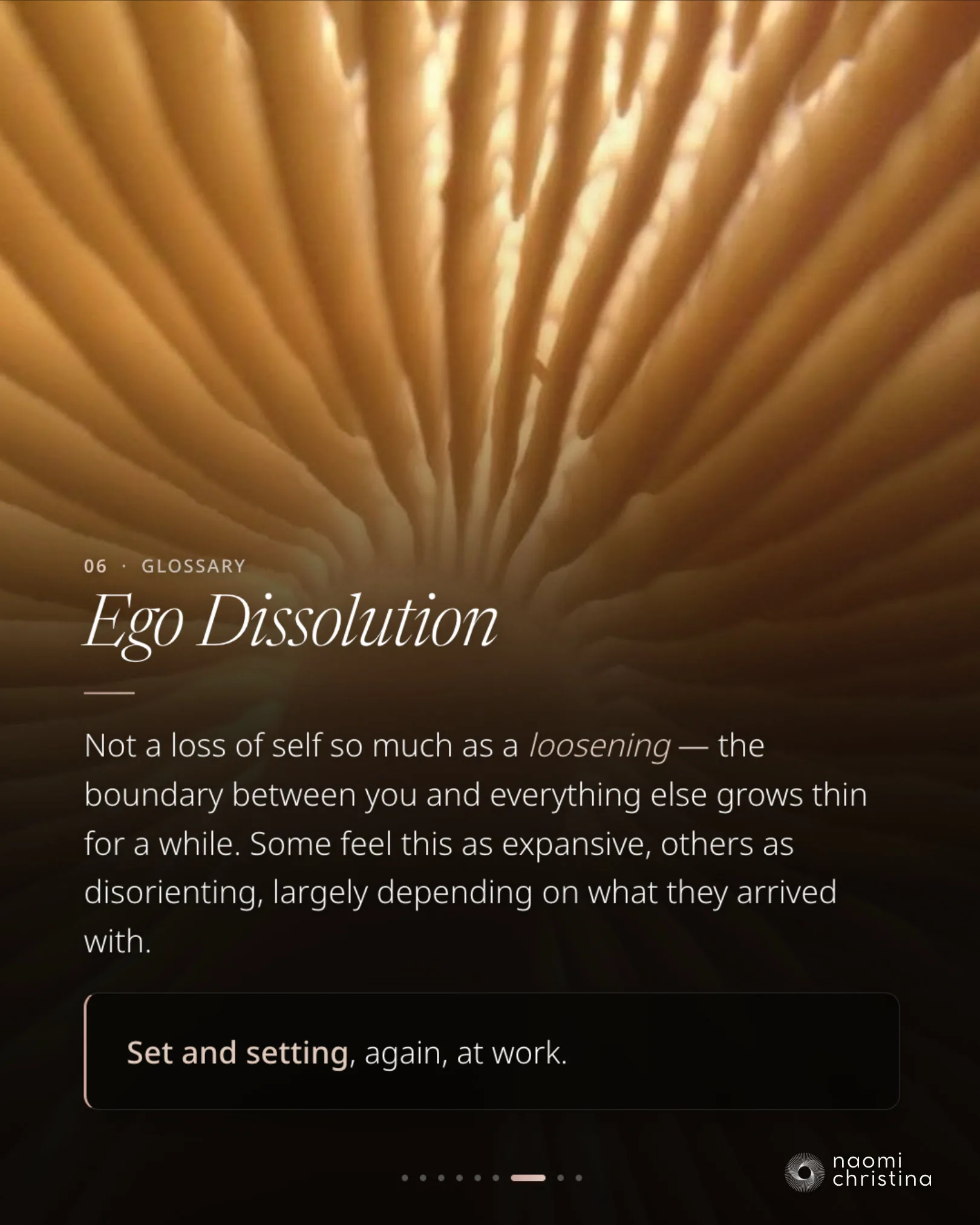
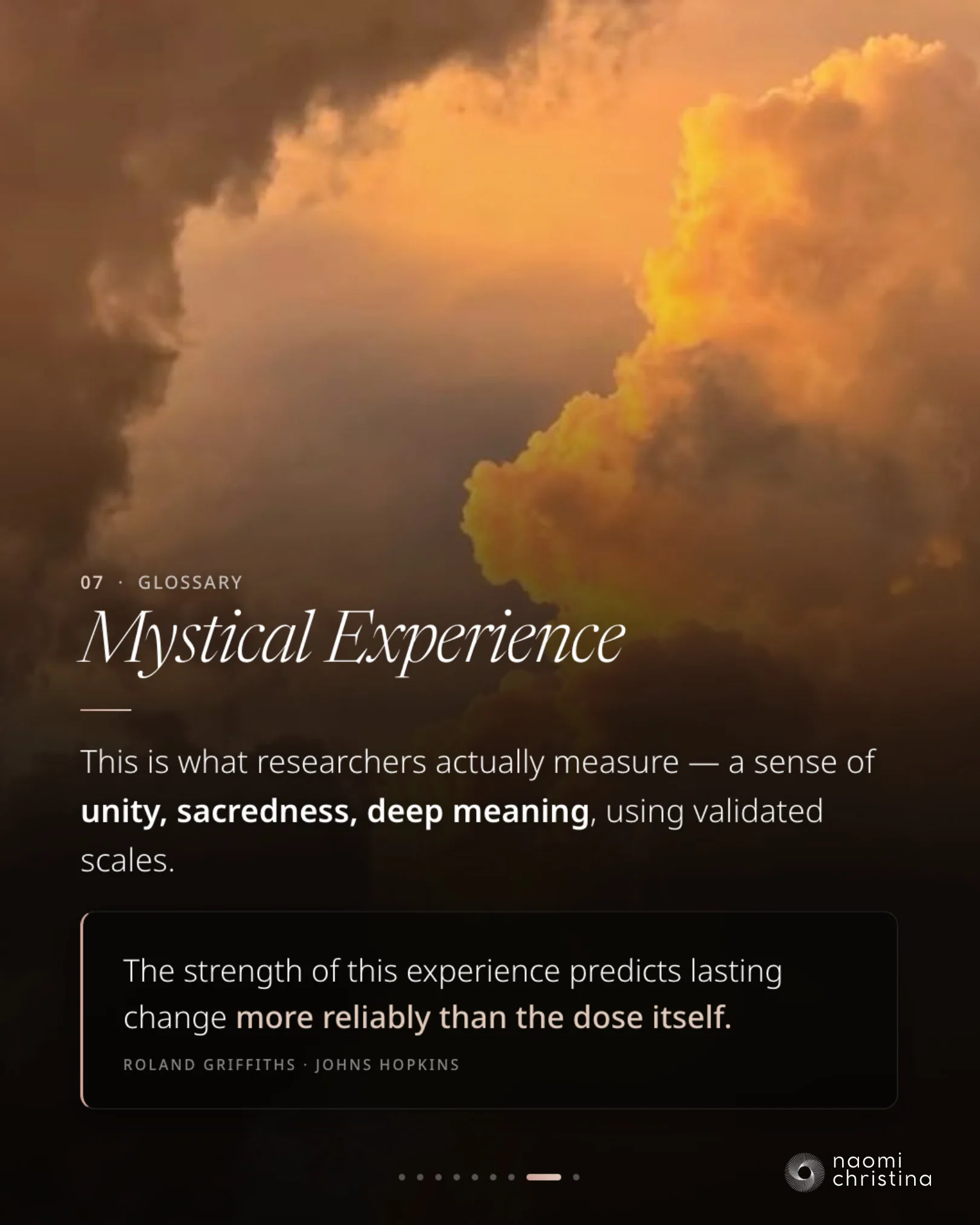
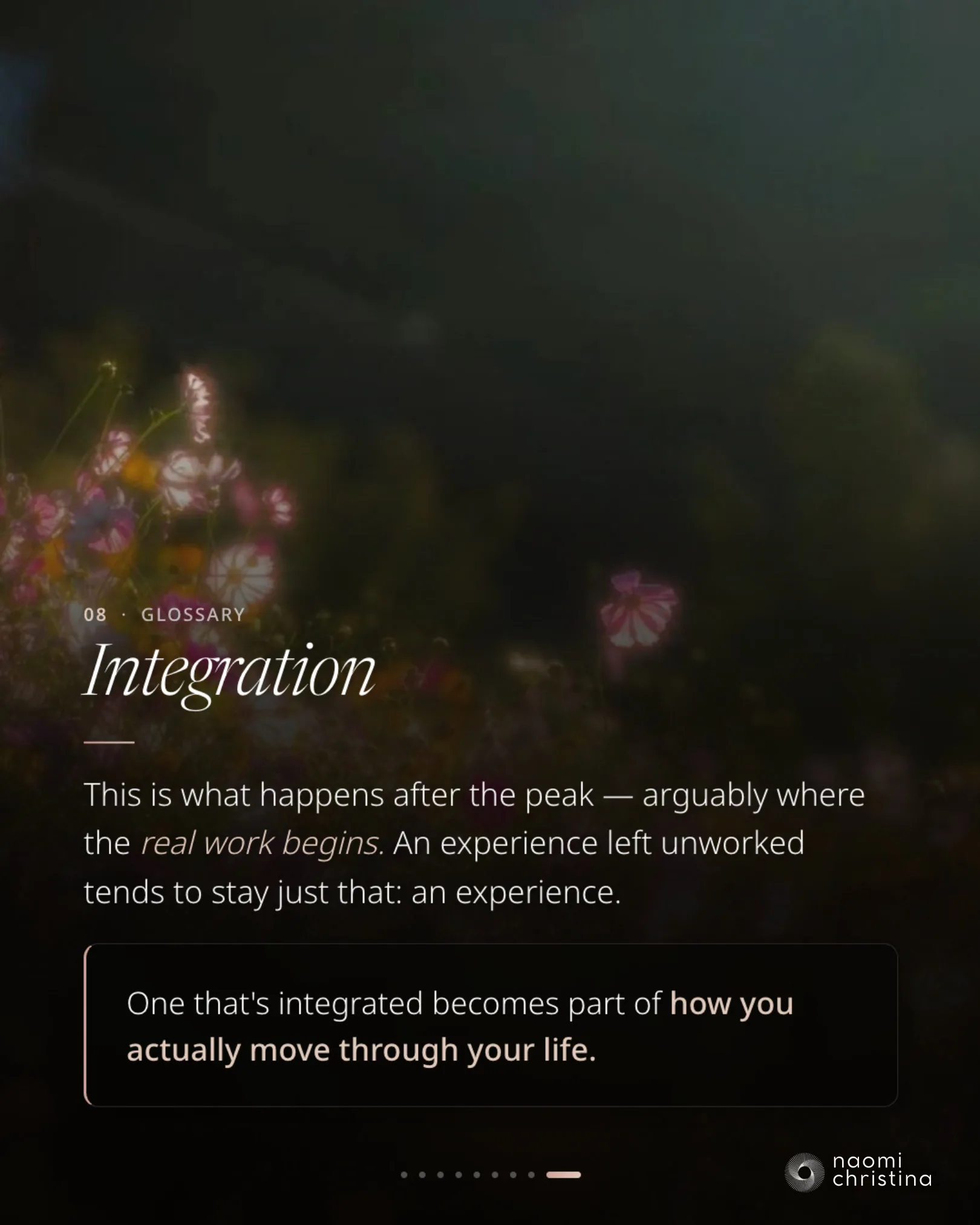
That's why I put together this small glossary. Not to sound clinical, but because these words describe the architecture of a psychedelic experience: the elements that shape it before, during, and long after the journey itself.
Your state going in—your mood, expectations, and the nervous system you're carrying that day—shapes almost everything that follows. The room, the people present, the music, the sense of safety—or its absence—do the same.
Neither happens on the day itself.
Both are built in the weeks beforehand: building the therapeutic relationship, through preparation, the intention you set, and the person who is holding space.
Research suggests that the depth of meaning people experience predicts lasting change more strongly than the dose itself. But even profound insights only become real change through integration—through the conversations, reflection, and small choices that follow.
Because perhaps the most important question isn't: "What's the right dose?"
It's: Who is holding the space around it?
Which one do you wish someone had explained to you sooner?
Read Ellen's story—and many others—in The Potential of Psychedelics.
Integration Is Not Thinking. It Is Embodying.
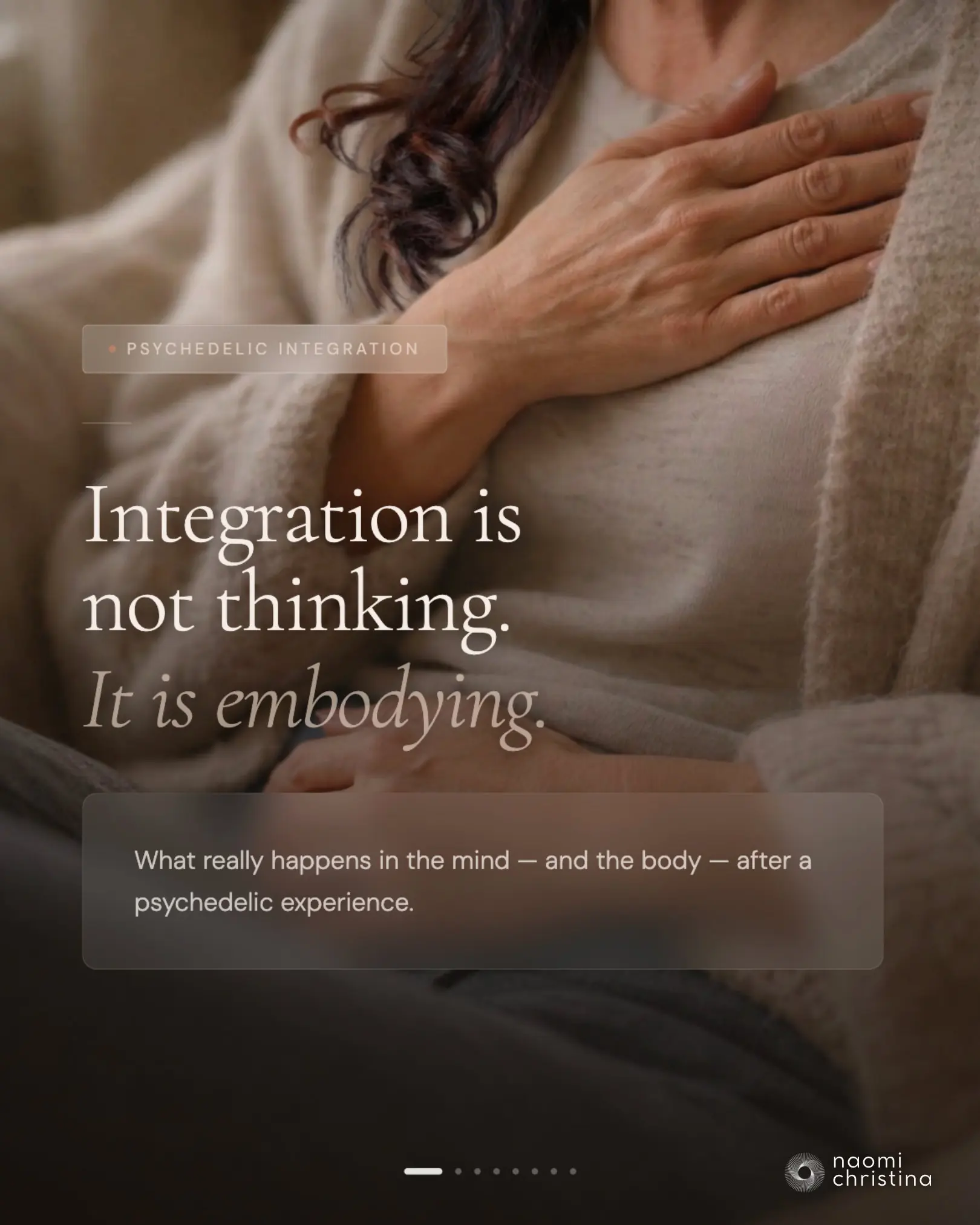
Integration is not thinking. It is embodying.
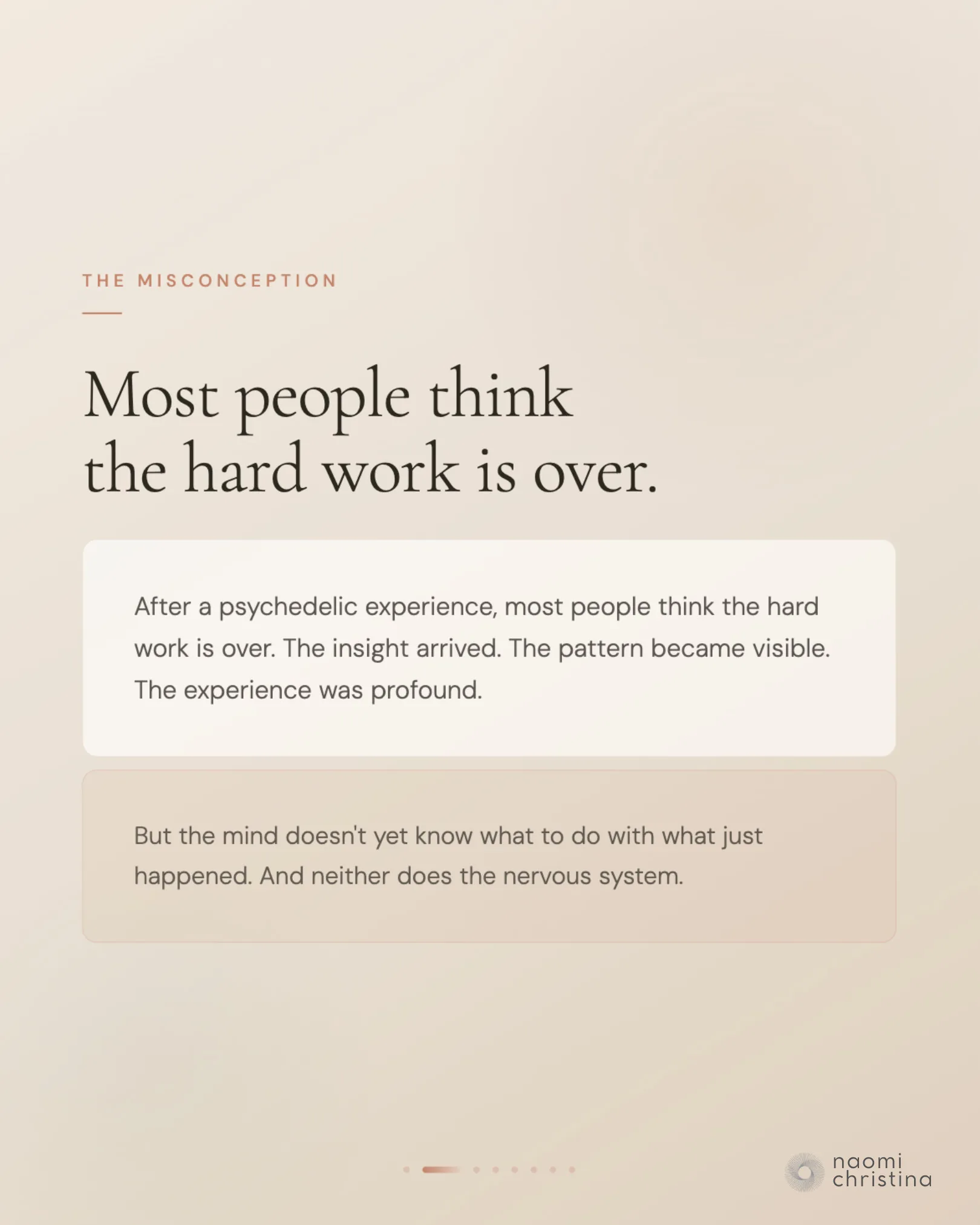
After a psychedelic experience, the mind doesn't yet know what to integrate.
This is one of the most important — and most overlooked — parts of the psychedelic process.
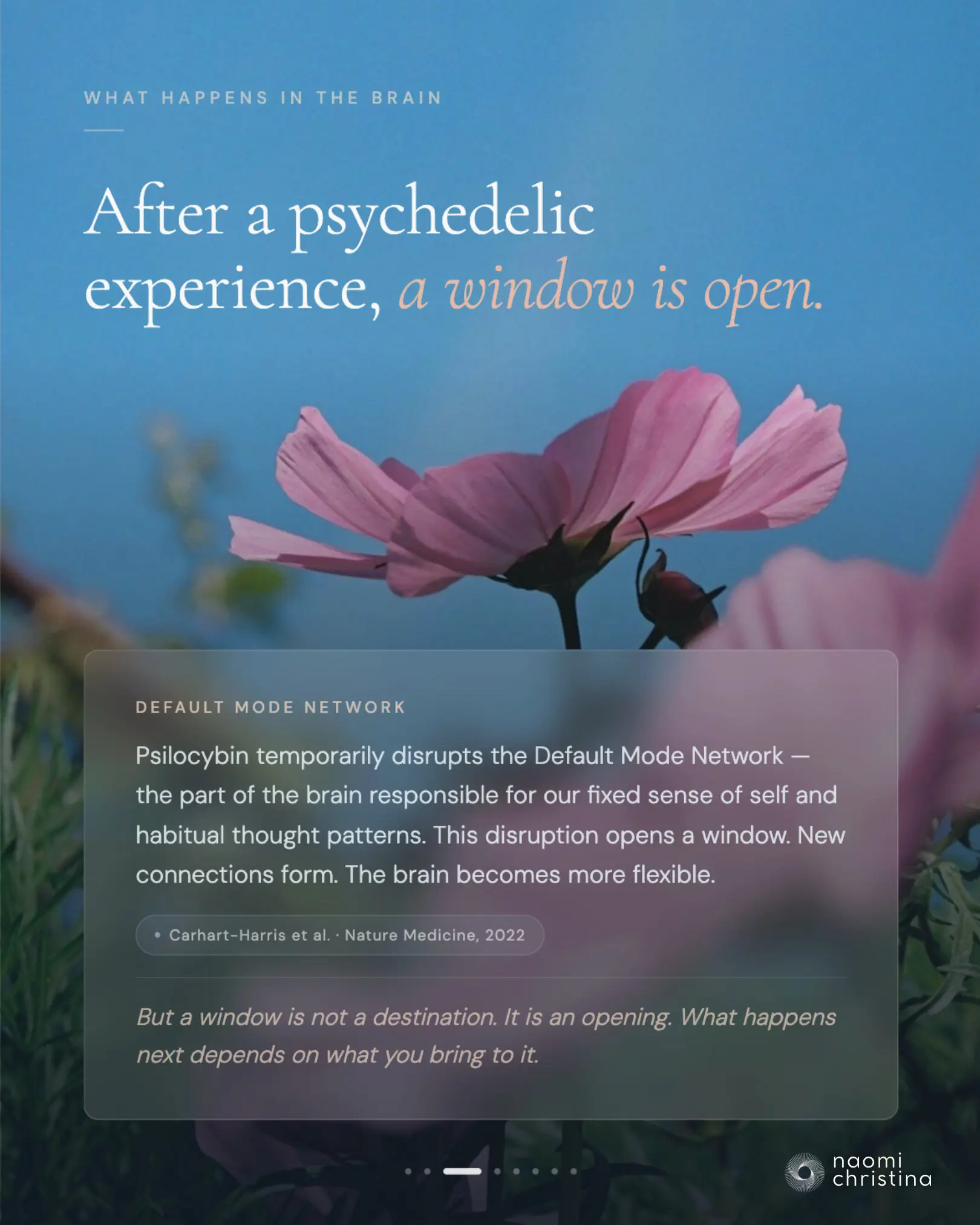
Robin Carhart-Harris's research at Imperial College London shows that psilocybin increases BDNF, a protein that supports the growth of new neural pathways. The brain enters a window of heightened neuroplasticity. New connections become possible.
But a window is not a destination.
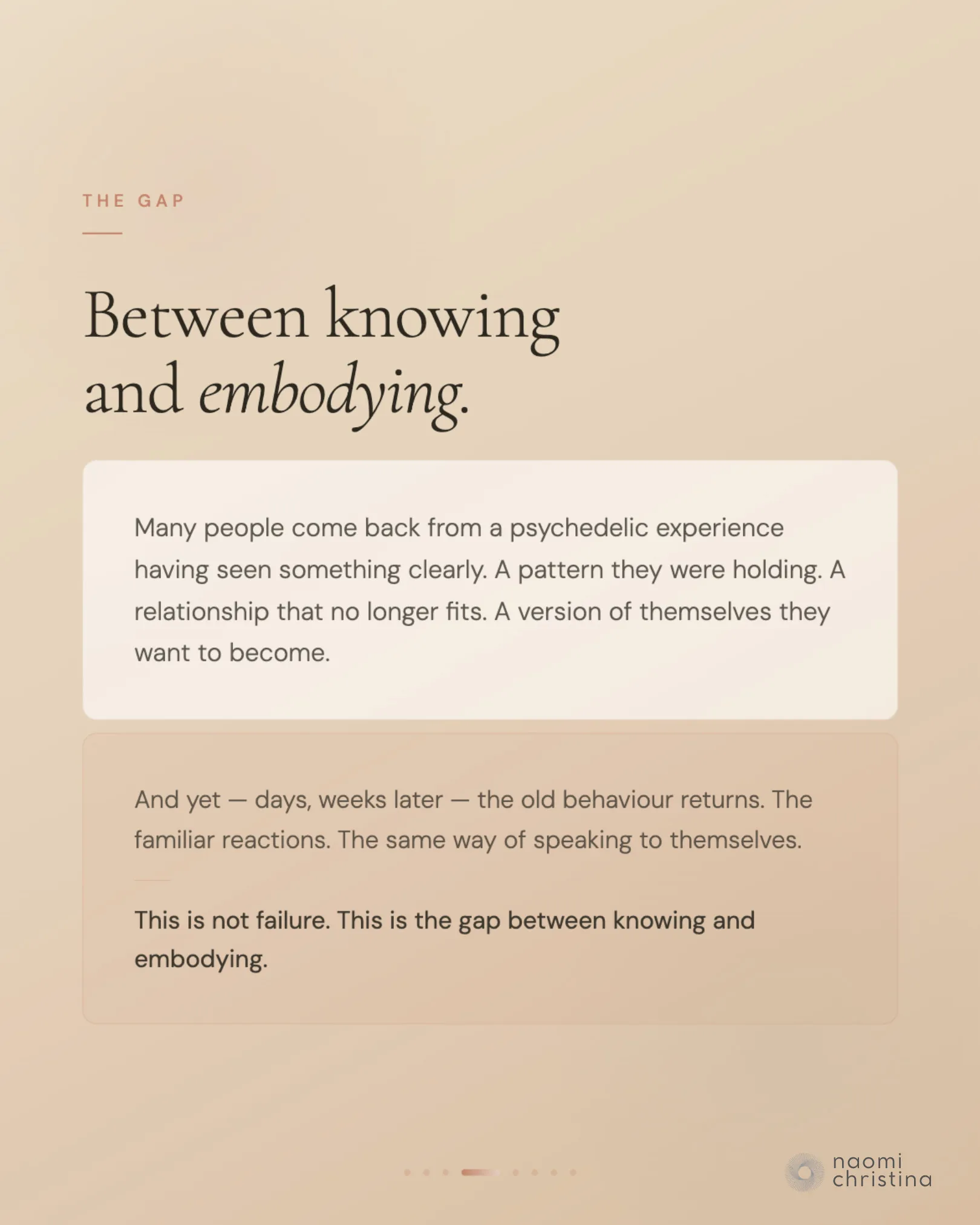
Many people return from a session having seen something clearly — a pattern, a grief, a version of themselves waiting to emerge. And yet, weeks later, the old responses return. The familiar inner voice. The same protective behaviour.
This is not failure. This is the gap between knowing and embodying.
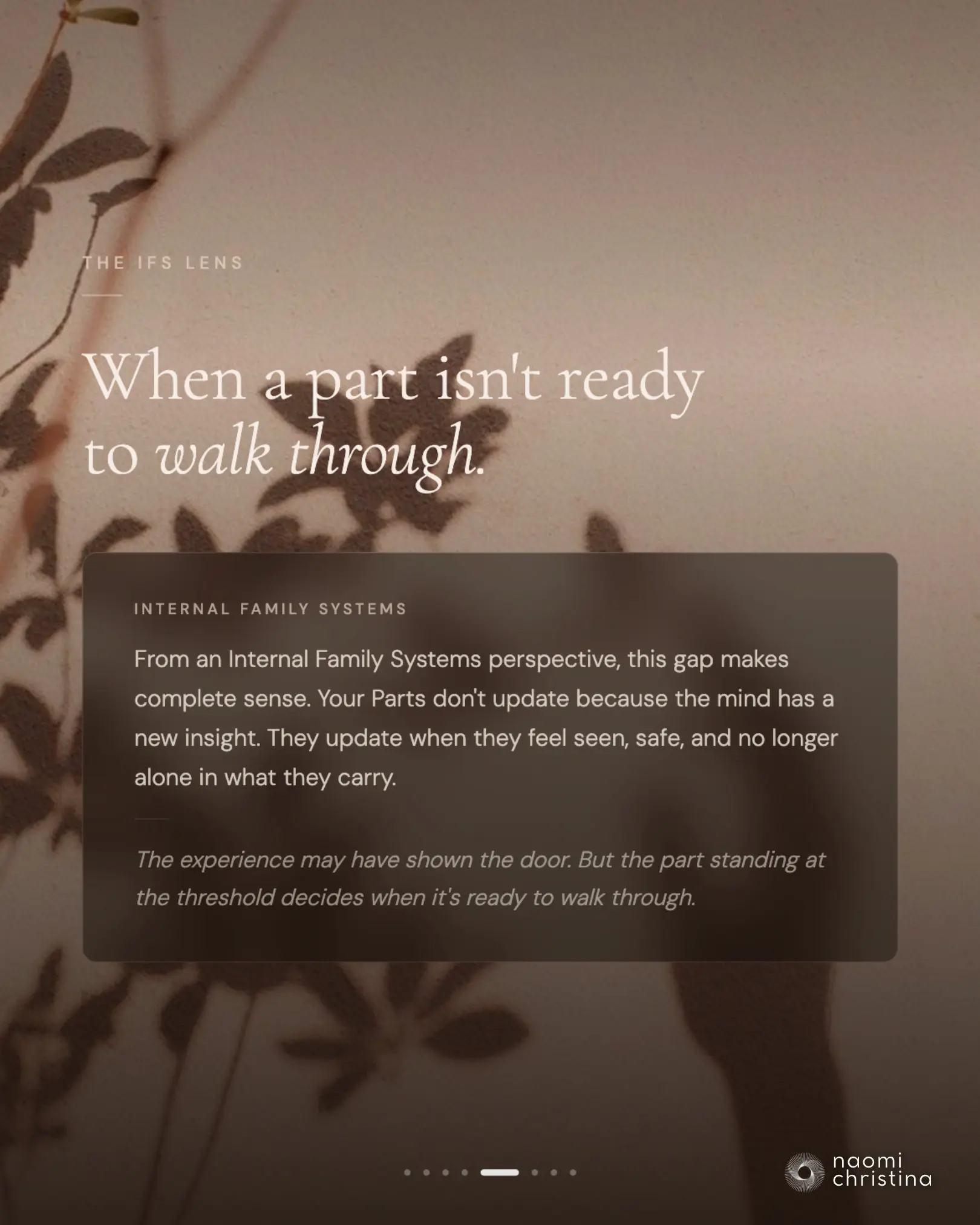
From an Internal Family Systems perspective, this makes complete sense. The conscious Self may have witnessed a transformation. But the protector parts — the one that learned to keep you safe long before any of this — has not yet been included in what changed. Parts don't update because the mind has a new insight. They update when they feel safe, seen, and no longer alone in what they carry.
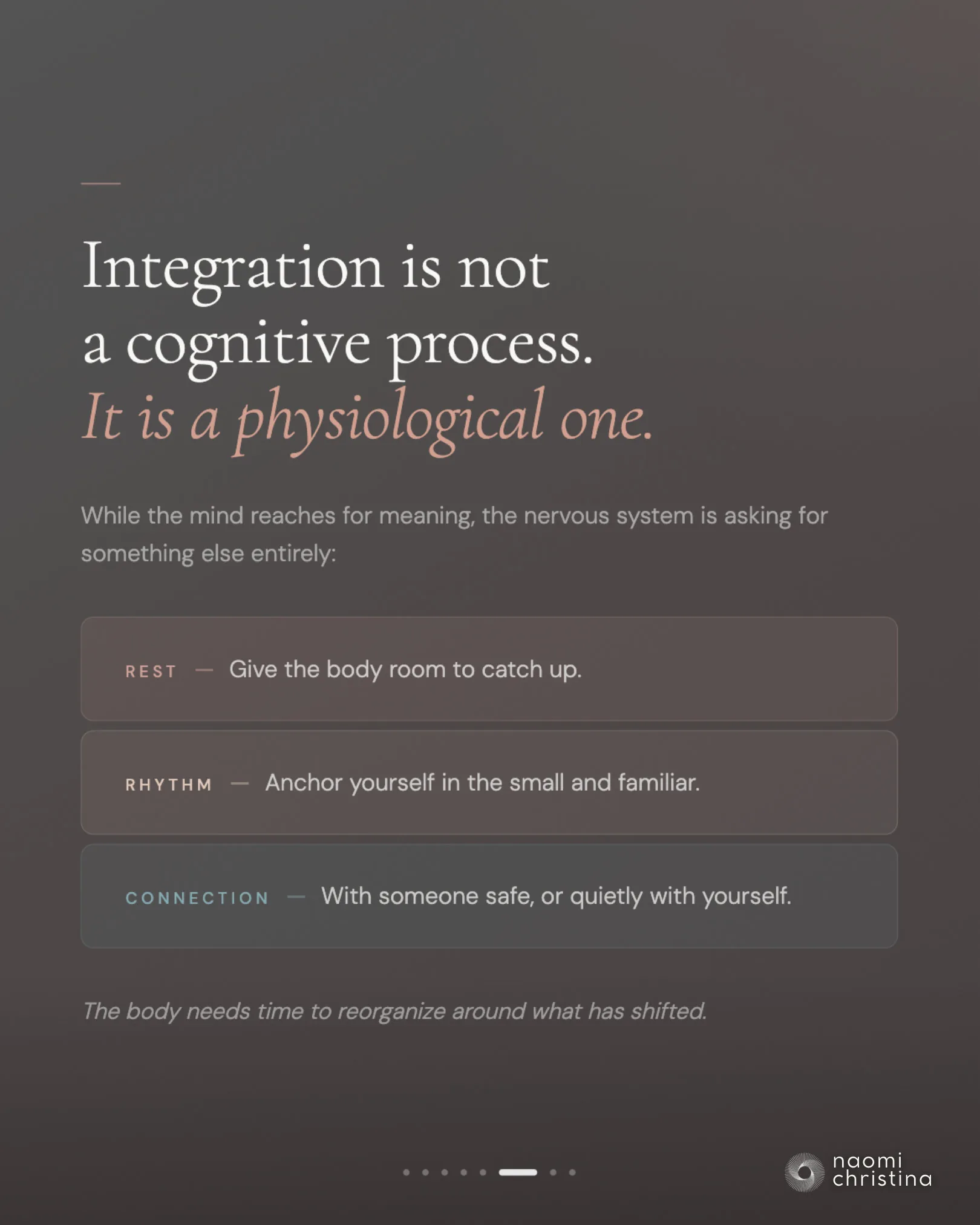
And while the mind reaches for meaning, the nervous system is asking for something else entirely.
Rest. Rhythm. Connection.
Not more processing. Not more analysis. Not more doing.
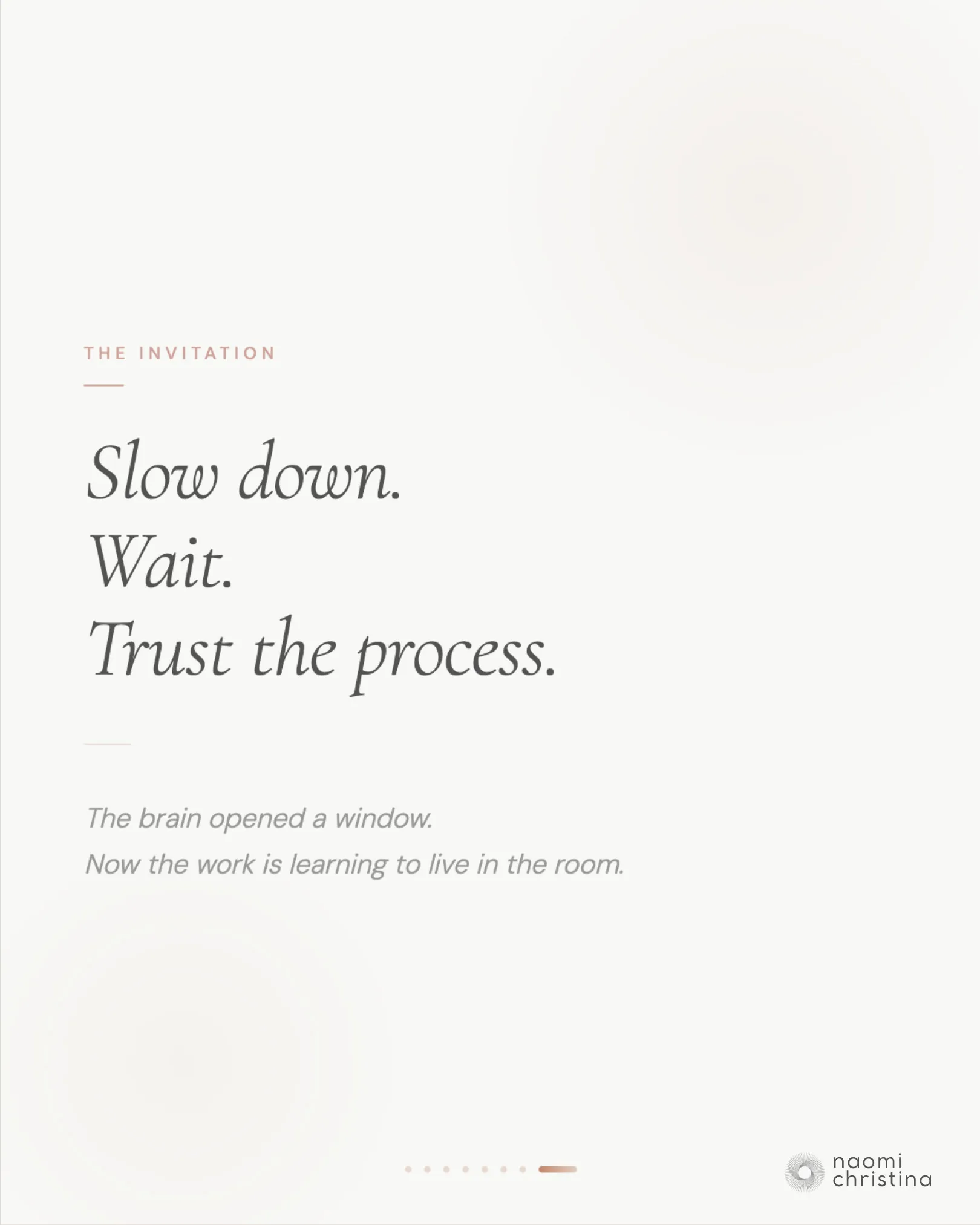
In The Potential of Psychedelics, I describe integration as one of the most underestimated phases of the entire process — not because people don't know it matters, but because it asks something our culture rarely rewards: to slow down, wait, and trust.
The brain opened a window. The work now is learning to live in the room.
What has surprised you most in the days after a deep inner experience — or after any significant shift?
- Carhart-Harris, R. L., et al. (2022). Increased global integration in the brain after psilocybin therapy for depression. Nature Medicine.
- Hutten, N.R.P.W., et al. (2020). Low doses of LSD acutely increase BDNF blood plasma levels in healthy volunteers. ACS Pharmacology & Translational Science, 4(2), 461–466.
- Van der Kolk, B.A. (2014). The Body Keeps the Score. Viking.
- Schwartz, R.C., & Sweezy, M. (2019). Internal Family Systems Therapy (2nd ed.). Guilford Press.
- Stubbé, N. (2025). Het potentieel van psychedelica.