A framework that is reshaping how researchers and clinicians understand the psychedelic therapeutic experience — and what it reveals about the mind’s capacity to heal itself.
By Naomi Stubbé and Francisca Niklitschek
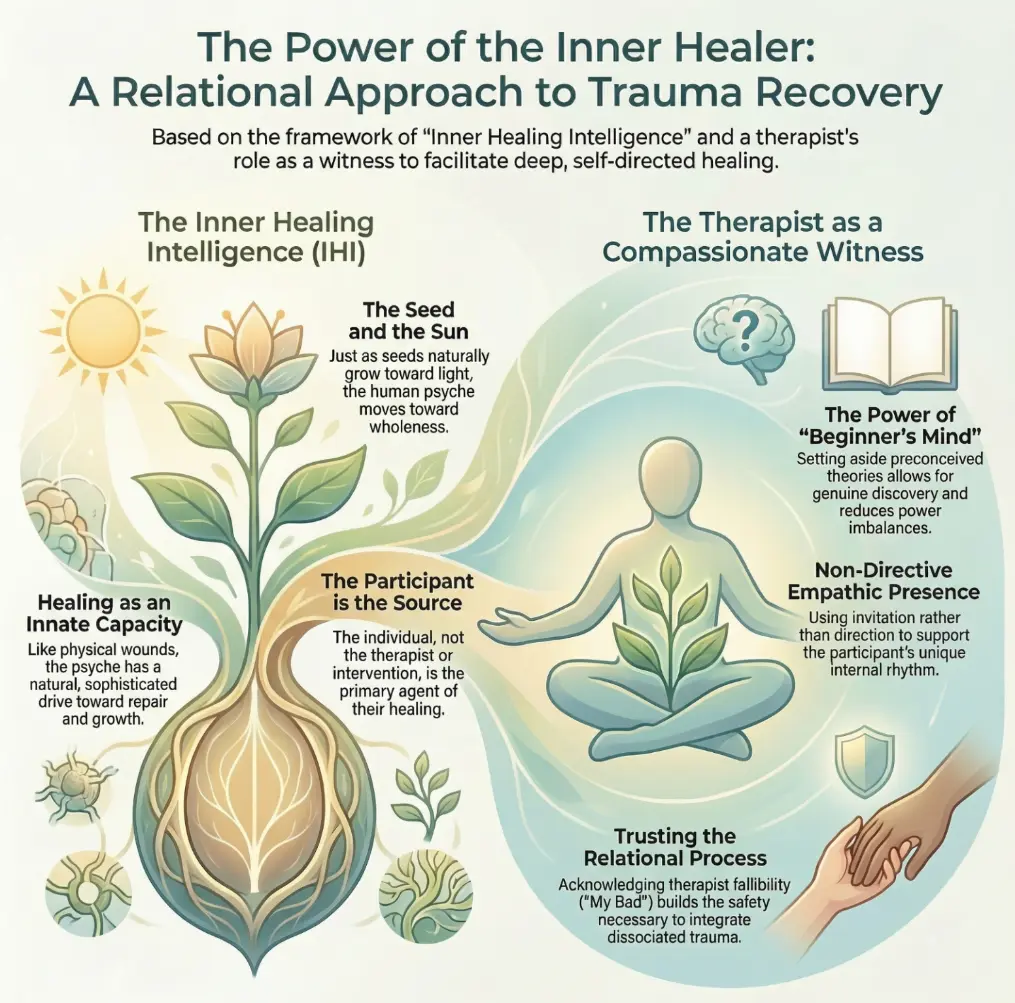
In psychedelic-assisted therapy, guides are often instructed to do something that runs counter to the instincts of most trained clinicians: step back. Rather than direct the session, interpret the experience, or steer the participant toward resolution, the guide’s primary task is to trust — trust that the participant’s own system knows where it needs to go.
This orientation rests on a concept that has quietly become central to the field: inner healing intelligence. It is the idea that human beings carry within them an inherent capacity not merely to survive psychological difficulty, but to move through it, process it, and integrate it — given the right conditions. In psychedelic research, this capacity appears to be not just theoretically useful but measurably present, with preliminary evidence suggesting that its activation is linked to therapeutic outcomes.
This article explores what inner healing intelligence is, how it relates to parallel frameworks in IFS therapy and somatic psychology, what the emerging science says, and what it means for our understanding of healing — with or without psychedelics.
A Concept at the Intersection of Several Traditions
The phrase ‘inner healing intelligence’ is most commonly associated with psychedelic-assisted therapy, particularly the therapeutic protocols developed by MAPS (Multidisciplinary Association for Psychedelic Studies) for MDMA-assisted therapy and those used in psilocybin research at Johns Hopkins, Imperial College London, and the Beckley Foundation.
In the MAPS treatment manual for MDMA-assisted therapy, therapists are explicitly instructed to encourage participants to trust in this inner capacity as a primary source of therapeutic change — not the therapist’s interpretations, and not the drug itself. The therapist’s role is to help create conditions in which the participant’s own healing process can unfold (Mithoefer, 2017, pp. 7, 10).
But the concept is older and wider than its current clinical usage. It draws on at least four converging traditions:
Vitalism and indigenous healing traditions — the understanding, common across many cultures, that living systems have an inherent tendency toward wholeness and that healing is a natural function of the organism, not an intervention imposed from outside.
Humanistic psychology — Carl Rogers’ concept of the actualising tendency, the organism’s inherent drive toward growth, complexity, and fuller functioning. For Rogers, the therapeutic relationship’s purpose was not to direct change but to create conditions safe enough for this tendency to operate (Rogers, 1961, pp. 35–38).
Transpersonal and psychedelic psychiatry — the foundational work of Stanislav Grof, whose decades of research with LSD and later with Holotropic Breathwork led him to articulate a remarkably similar concept. Grof described the psyche as possessing an inherent self-healing function, and the therapist’s role as one of trusting and supporting the process rather than directing it. In LSD Psychotherapy (1980), he documented how non-ordinary states of consciousness reliably moved participants toward the processing and integration of difficult material when the conditions of safety and trust were established. In The Holotropic Mind (1992), he extended this framework into a broader model of consciousness, arguing that the movement toward wholeness is a fundamental property of the human psyche (Grof, 1980; Grof & Bennett, 1992).
Somatic and trauma-informed approaches — the work of Peter Levine, Bessel van der Kolk, and Pat Ogden, which emphasises that the body holds its own intelligence and, given sufficient safety and attunement, will move toward discharge, regulation, and integration (Levine, 2010; van der Kolk, 2014).
What psychedelic-assisted therapy appears to do is create conditions in which these pre-existing capacities become dramatically more accessible — faster, more vivid, and often more complete than in conventional talk therapy alone.
The IFS Parallel: Self as the Source of Healing
One of the most striking convergences in contemporary psychotherapy is the parallel between inner healing intelligence, as described in psychedelic research, and the core discovery at the heart of Internal Family Systems (IFS) therapy.
Richard Schwartz, the founder of IFS, describes what he calls the Self — a stable, undamaged core of consciousness characterised by eight qualities: calmness, curiosity, compassion, clarity, creativity, courage, connectedness, and confidence. In thousands of clinical hours with clients across a wide range of presentations and histories, Schwartz found that this Self was universally present — and universally capable of facilitating healing within the person’s inner system.
The Self is in everybody. Furthermore, the Self cannot be damaged, the Self doesn’t have to develop, and the Self possesses its own wisdom about how to heal internal as well as external relationships. — Richard Schwartz, No Bad Parts (2021)
In IFS, healing does not come from the therapist doing something to the client. It comes from helping the client’s Self come forward — and from that Self-led place, relating with compassion and curiosity to the protective and wounded parts that have been keeping the person stuck. The therapist creates conditions; the Self heals.
Schwartz has noted the resonance between IFS and psychedelic therapy explicitly. In particular, he has observed that MDMA appears to help protector parts relax their vigilance, enabling access to the Self — and that participants in MDMA-assisted therapy for PTSD spontaneously begin working with their inner parts in a Self-led way, without any IFS instruction. The process that IFS maps in careful steps seems to emerge organically when the right conditions — safety, openness, reduced threat response — are in place.
This convergence is significant. It suggests that inner healing intelligence is not a poetic metaphor or a purely spiritual claim. It is a description of something that can be reached by multiple therapeutic routes — and that appears to follow recognisable patterns when it does.
What the Research Shows
The scientific literature on inner healing intelligence is still young, but it is growing — and it is more substantive than the phrase alone might suggest.
A 2024 study on psilocybin-assisted therapy found that ‘inner healer’ scores — measured via self-report scales assessing a sense of internal guidance, self-trust, and healing presence — were significantly higher following a high-dose session than following placebo. Critically, higher inner healer scores were associated with greater reductions in depressive symptoms at a two-week follow-up (Peill et al., 2024).
A 2024 review published in Frontiers in Psychology examined the concept across several therapeutic traditions, concluding that inner healing intelligence is ‘scientifically nascent’ but not without empirical grounding. The review distinguished between inner healing intelligence as a reported subjective experience (consistently described by participants), as a clinical framework (useful for guiding therapeutic practice), and as a biological mechanism (insufficiently understood and requiring further investigation) (Fischman, 2025).
Supporting evidence also comes from the broader psychedelic literature. Research on the neurological effects of psilocybin, particularly the work of Robin Carhart-Harris and colleagues at Imperial College London, has documented how classical psychedelics temporarily disrupt the default mode network (DMN) — the neural architecture associated with the self-referential, ruminating, narrative mind. This disruption appears to create a window of increased neuroplasticity, in which rigid patterns of thought, emotion, and self-concept become more fluid and open to reorganisation (Carhart-Harris & Friston, 2019).
The therapeutic implication is that in this window, the person’s own system — freed from some of its habitual constraints — can do work that is ordinarily difficult or impossible. This is not the psychedelic doing the healing. It is the psychedelic creating conditions in which the person’s own healing intelligence can operate more freely.
Set, Setting, and the Architecture of Trust
If inner healing intelligence is a capacity that needs conditions to activate, then the clinical implication is clear: therapeutic context is not secondary to the ‘active ingredient.’ It is part of the mechanism.
This is precisely what the research on set and setting has long suggested. ‘Set’ refers to the participant’s mindset, intentions, and psychological state entering the experience. ‘Setting’ refers to the environment — physical, relational, and cultural — in which it occurs. Both profoundly shape what happens and what is therapeutically possible.
In my book The Potential of Psychedelics, I describe the guide’s role as one of giving space to the participant’s inner wisdom — not directing, not interpreting, but witnessing and holding a presence of trust. Janis Phelps (2017), whose work has shaped training in psychedelic therapy internationally, identifies trust as operating on three levels in this context: trust in the guide, trust in the process, and — crucially — trust in one’s own inner healing intelligence.
The therapeutic relationship, then, is partly a vehicle for modelling that trust. When a participant feels genuinely witnessed, unconditionally safe, and free from the pressure to produce particular kinds of experiences or insights, something in the system relaxes. And from that relaxation, deeper material can surface and be metabolised.
This is not unique to psychedelic therapy. The same dynamic is described in EMDR, in somatic experiencing, in attachment-based psychotherapy, and in IFS. Across modalities, the consistent finding is that safety — real, relational, embodied safety — is not merely the container for healing. It is one of its primary catalysts.
What This Invites Us to Consider
There is something quietly radical in the concept of inner healing intelligence — not because it is new, but because it runs so directly against the dominant frameworks through which we tend to understand psychological suffering and its treatment.
The biomedical model, which still largely shapes how mental health care is organised and funded, positions the person as a patient with a disorder — something broken that needs to be fixed, corrected, or managed from the outside. The inner healing intelligence framework reverses this. It positions the person as someone carrying capacities that, under the right conditions, can move toward coherence on their own terms.
This is not a naive claim. It does not say that suffering will simply resolve if given sufficient time, or that external support is unnecessary, or that all wounds heal without skilled assistance. What it says is that the direction of healing — its shape, its timing, its meaning — is often best discovered from within the person rather than imposed from without.
For practitioners, this is an invitation to examine a subtle but important question: when working with clients, where does the authority ultimately rest? In the clinician’s expertise, their diagnostic frameworks, their models of what healing should look like? Or in the client’s own system, with the practitioner as a skilled, present, and trusted companion?
For individuals doing any form of inner work — whether through therapy, psychedelics, somatic practice, or contemplative discipline — there may be something worth sitting with here. The part of you that already knows. The movement toward wholeness that is, perhaps, already underway.
Conclusion
Inner healing intelligence describes a real phenomenon — one documented across therapeutic traditions, emerging empirical research, and centuries of clinical and spiritual observation. It is the mind’s capacity to process, integrate, and move toward coherence when the conditions of safety, trust, and openness are in place. In psychedelic-assisted therapy, those conditions appear to become available with unusual speed and depth, which may help explain why this framework has become so central to the field.
What remains to be understood is the precise mechanism: whether inner healing intelligence is best described as a psychological process, a neurobiological state, a relational dynamic, or some combination of all three. Future research will need to disentangle these threads. But the convergence across IFS, somatic therapies, and psychedelic research already suggests something important: that the capacity for healing is not primarily something that needs to be installed from outside. It is something that needs room to emerge.
Disclaimer
This article is intended for informational and educational purposes only. It does not constitute medical or psychological advice. If you are experiencing mental health difficulties or considering any therapeutic intervention, please consult a qualified healthcare professional.
References
- Carhart-Harris, R. L., & Friston, K. J. (2019). REBUS and the Anarchic Brain: Toward a Unified Model of the Brain Action of Psychedelics. Pharmacological Reviews, 71(3), 316–344. https://pmc.ncbi.nlm.nih.gov/articles/PMC6588209/
- Peill, J., Marguilho, M., Erritzoe, D., Barba, T., Greenway, K. T., Rosas, F., Timmermann, C., & Carhart-Harris, R. (2024). Psychedelics and the ‘inner healer’: Myth or mechanism? Journal of Psychopharmacology, 38(5), 417–424. https://pubmed.ncbi.nlm.nih.gov/38605658/
- Levine, P. A. (2010). In an Unspoken Voice: How the Body Releases Trauma and Restores Goodness. North Atlantic Books.
- Mithoefer, M. (2017). MDMA-Assisted Psychotherapy Treatment Manual (Version 8.1). MAPS. https://maps.org/wp-content/uploads/2022/05/MDMA-Assisted-Psychotherapy-Treatment-Manual-V8.1-22AUG2017.pdf
- Phelps, J. (2017). Developing guidelines and competencies for the training of psychedelic therapists. Journal of Humanistic Psychology, 57(5), 450–487. https://journals.sagepub.com/doi/abs/10.1177/0022167817711304
- Grof, S. (1980). LSD Psychotherapy. Hunter House.
- Grof, S., & Bennett, H. Z. (1992). The Holotropic Mind: The Three Levels of Human Consciousness and How They Shape Our Lives. HarperCollins.
- Rogers, C. R. (1961). On Becoming a Person: A Therapist’s View of Psychotherapy. Houghton Mifflin.
- Schwartz, R. C. (2021). No Bad Parts: Healing Trauma and Restoring Wholeness with the Internal Family Systems Model. Sounds True.
- Stubbé, N. (2025). The Potential of Psychedelics [Het potentieel van psychedelica].
- van der Kolk, B. (2014). The Body Keeps the Score: Brain, Mind, and Body in the Healing of Trauma. Viking.
- Fischman, L. (2025). My Bad, You Got This: Witnessing, therapist attitude and the synergy between psychedelics and inner healing intelligence in the treatment of trauma. Frontiers in Psychology, 16, 1469559.https://www.frontiersin.org/journals/psychology/articles/10.3389/fpsyg.2025.1469559/full